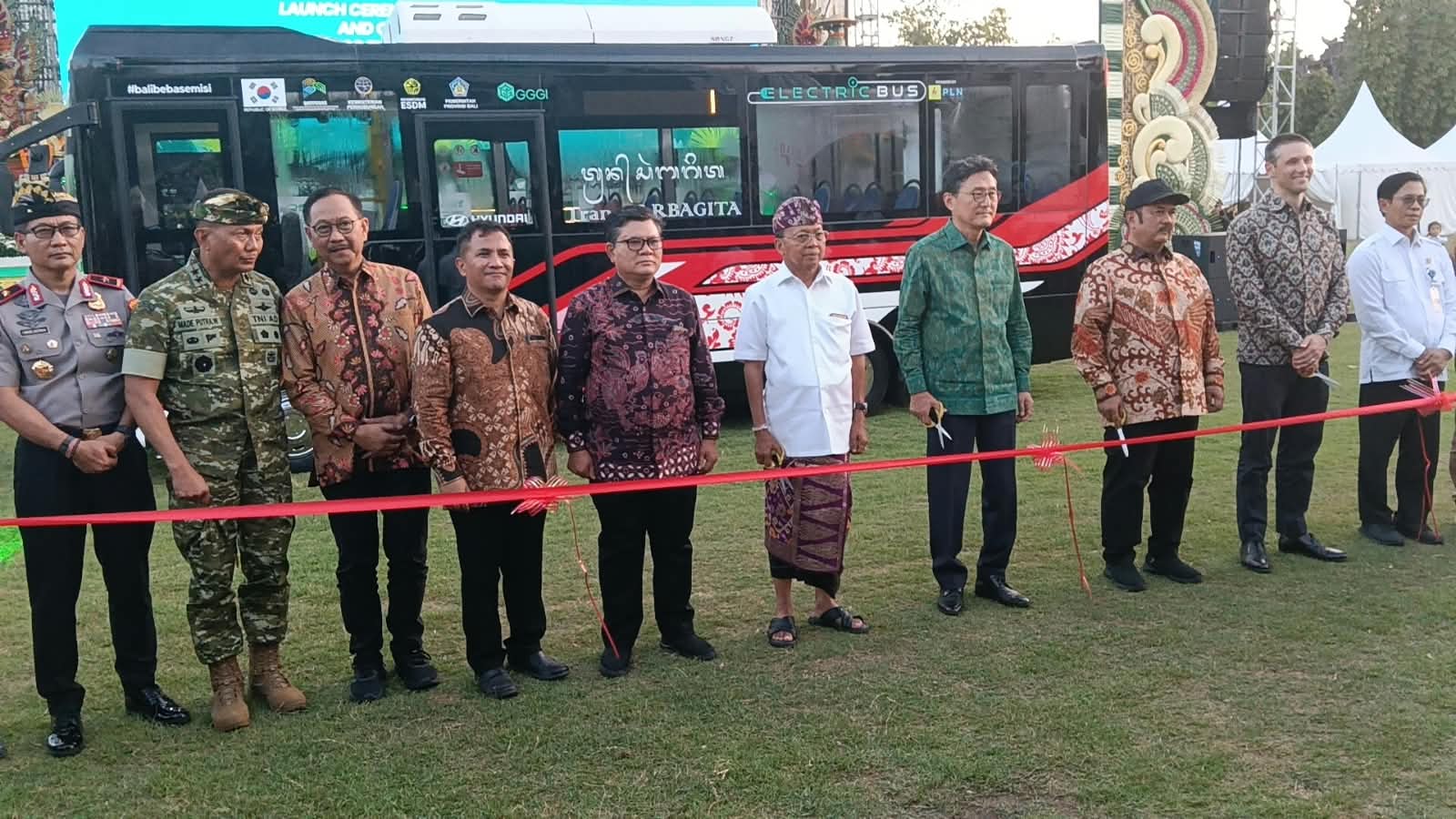
DENPASAR, BALINEWS — The Bali provincial government received 11 electric buses and six electric vehicle charging facilities from the Government of the Republic of Korea through the Bali E-Mobility Project on Thursday, October 22, 2026. The assistance is intended to support low-emission transportation and accelerate Bali’s transition to clean energy.
The handover ceremony and inauguration of the electric buses took place at Niti Mandala Square in Denpasar. The project was facilitated through cooperation with Indonesia’s Ministry of National Development Planning/National Development Planning Agency (Bappenas).
Bali Governor Wayan Koster urged residents to switch to battery-powered electric vehicles to reduce air pollution, minimize noise, and lower transportation costs.
“In the transportation and energy sectors, clean energy must be used throughout the entire process, from upstream to downstream,” Koster said.
He explained that the adoption of clean energy was part of Bali’s development vision, Nangun Sat Kerthi Loka Bali, which emphasizes environmental protection and sustainable development.
The Bali provincial government previously introduced Governor Regulation No. 48 of 2019 to promote battery-powered electric vehicles. However, implementation was limited by the COVID-19 pandemic and the subsequent recovery period.
Koster said he intended to accelerate the implementation of electric vehicle policies during his second term as governor. He also highlighted the potential cost savings associated with electric vehicles.
According to Koster, a round trip between Denpasar and Singaraja could cost approximately Rp500,000 using a conventional fuel-powered vehicle, compared with an estimated Rp140,000 using an electric car.
He also encouraged greater adoption of electric motorcycles, noting that two-wheelers remain an important means of transportation for Bali residents.
Meanwhile, National Development Planning Minister and Bappenas Head Rachmat Pambudy expressed his appreciation to the Government of the Republic of Korea, the Global Green Growth Institute (GGGI), the Ministry of Transportation, the Ministry of Energy and Mineral Resources, the Bali provincial government, and other stakeholders involved in the Bali E-Mobility Project.
Rachmat said the cooperation was part of broader efforts to promote sustainable development in line with the United Nations Sustainable Development Goals (SDGs).
Bali is expected to serve as a pilot region, with its experience potentially providing a reference for sustainable development initiatives in other parts of Indonesia.
The donation of 11 electric buses and six charging facilities is expected to strengthen environmentally friendly public transportation in Bali and support the wider adoption of clean energy in the transportation sector.