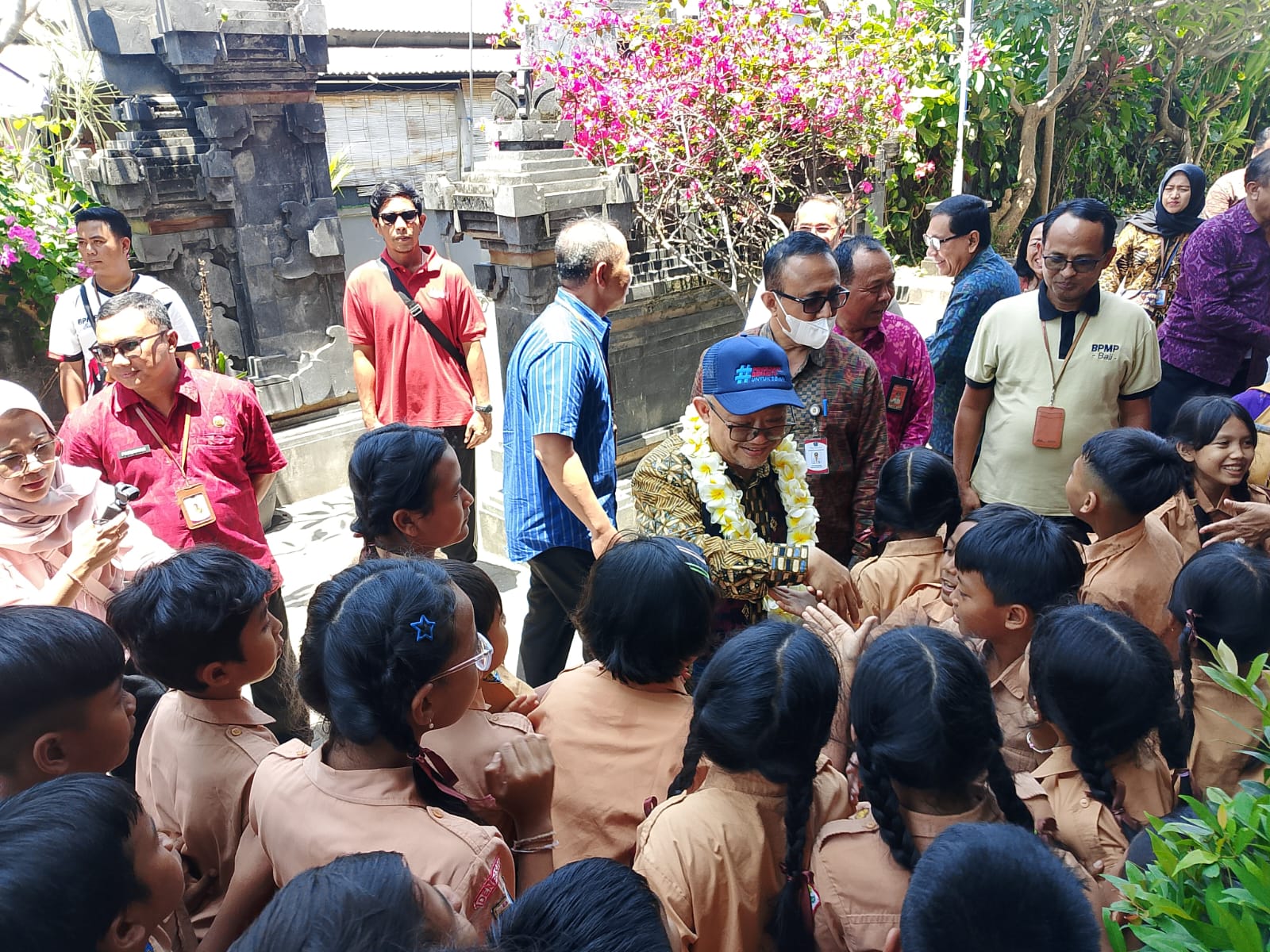
DENPASAR, BALINEWS — Minister of Primary and Secondary Education Abdul Mu’ti visited two schools in Bali on Friday (Oct. 2, 2026), to review the implementation of the School Revitalization Program funded through the 2026 state budget.
Mu’ti first visited Indraprasta Kindergarten in Kuta, Badung Regency, before continuing to SDN 15 Dangin Puri in Denpasar.
The visits were aimed at directly monitoring the implementation of the School Revitalization Program while assessing conditions and learning activities at the schools. The program is part of the government’s efforts to improve the quality of basic education and strengthen learning environments across the country.
During the visits, Mu’ti interacted with students and teachers and observed classroom activities and school facilities. His presence was warmly welcomed by students, teachers, and other members of the school communities.
The visits also provided an opportunity for the minister to communicate directly with teachers and students about the needs and challenges they face in delivering education.
In Bali, the total allocation for the School Revitalization Program in 2026 reached Rp272.66 billion, with funding earmarked for improvements at 401 schools across the province.
Each participating school is also set to receive three interactive flat panels (IFPs) as part of the government’s efforts to support technology-based learning.
“SDN 15 Dangin Puri has already received the assistance, and Indraprasta Kindergarten in Badung has also received it. Both schools have also received the Free Nutritious Meals program. Alhamdulillah, everything is running smoothly,” Mu’ti said.
In Badung Regency, 22 educational institutions from kindergarten through senior high school level are included in the revitalization program.
Meanwhile, Denpasar is set to revitalize 16 schools in 2026, with a total budget of Rp18.89 billion. The program covers schools ranging from kindergarten to senior high school.
Denpasar Mayor I Gusti Ngurah Jaya Negara said government assistance for school improvements had increased significantly in 2026.
By comparison, the Ministry of Primary and Secondary Education allocated funding for the revitalization of only nine educational institutions in Denpasar in 2025, with a total budget of Rp6.14 billion and 640 IFP units.
“The assistance for SDN 15 Dangin Puri covers four classrooms and improvements to the school grounds. This is very helpful for us in Denpasar, especially because the total allocation in 2026 is nearly Rp18 billion. That represents a very significant increase,” Jaya Negara said.
The revitalization projects are being carried out through a self-managed system at each educational institution. According to the government, the approach also helps create employment opportunities.
Across Bali, more than 400,000 people are involved in the School Revitalization Program across various levels of education, from kindergarten through senior high school and equivalent institutions.
Beyond school infrastructure, Mu’ti also emphasized the importance of strengthening students’ character through education policies that go beyond academic achievement.
One of the programs introduced by the Ministry of Primary and Secondary Education is the “Seven Habits of Great Indonesian Children” movement. The program promotes seven daily habits: waking up early, practicing religious faith, exercising, eating healthy and nutritious food, developing a habit of learning, engaging in community life, and going to bed early.
When Mu’ti arrived at SDN 15 Dangin Puri, students welcomed him by singing a song about developing the seven basic character traits as part of efforts to build a high-quality generation of Indonesian children.