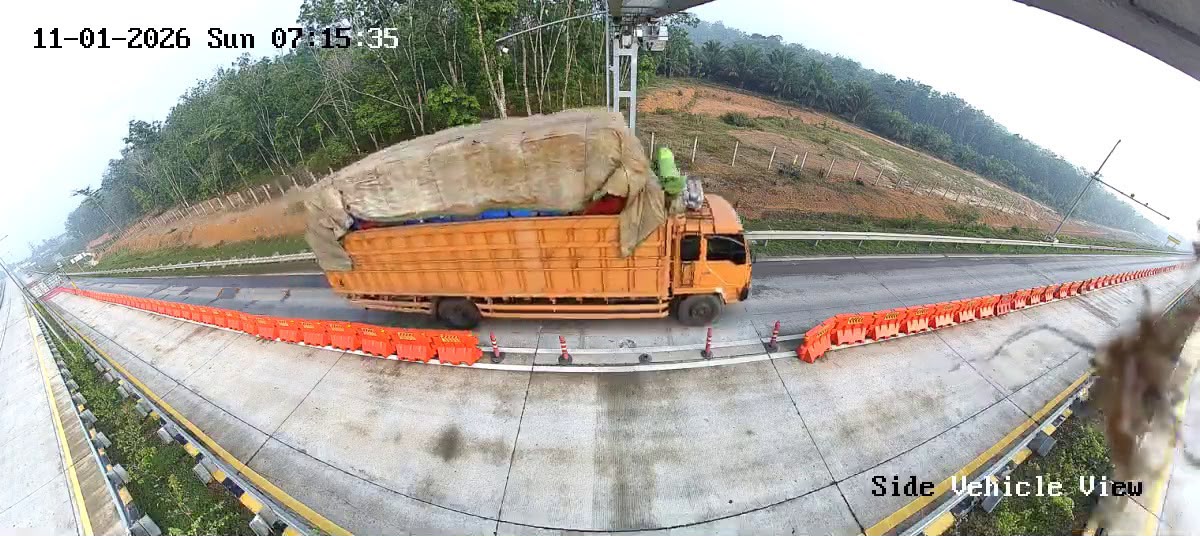
JAKARTA, BALINEWS – PT Hutama Karya (Persero) has stepped up its monitoring of vehicles classified as Over Dimension and Overloading (ODOL) on the Trans-Sumatra Toll Road (JTTS), warning that trucks found carrying loads beyond permitted limits may be prohibited from continuing their journeys and directed to turn back.
The measure aims to reduce the risk of traffic accidents caused by overloaded vehicles while protecting road users and maintaining the condition of toll road infrastructure.
Hutama Karya Executive Vice President of Corporate Secretary Hamdani said every freight vehicle has a maximum load capacity determined by its type and specifications. Exceeding that limit can make vehicles more difficult to control, particularly when braking, increasing the risk of accidents.
"Every truck has a load limit that must be observed. When a vehicle is overloaded, it becomes more difficult to control and the risk of accidents increases. Therefore, when vehicles found violating the regulations are instructed by officers to turn back, the intention is not to disrupt their journeys but to protect drivers and all other toll road users," Hamdani said.
The monitoring measures refer to applicable laws and regulations, including Government Regulation No. 74 of 2014 on Road Transportation. Article 70 paragraph (3), as cited in the company's public awareness materials, states that vehicles carrying loads exceeding the permitted limit by more than 5 percent may be prohibited from continuing their journeys.
To strengthen enforcement, Hutama Karya has also deployed Weigh-in-Motion (WIM) technology, a system that estimates vehicle weight as trucks pass over specially equipped road sensors without requiring them to stop.
The technology helps detect a vehicle's total weight as well as the load distributed across its individual axles. Vehicles flagged for potential overloading can then undergo further inspections by officers to verify compliance with applicable regulations.
In addition to using WIM technology, Hutama Karya conducts direct inspections of freight vehicles and coordinates with relevant government agencies to support more effective ODOL monitoring.
Hamdani said overloaded vehicles pose risks not only to drivers and other road users but also to road and bridge infrastructure. Excessive vehicle loads can place additional stress on infrastructure, accelerating deterioration and increasing maintenance requirements.
The company is also expanding public awareness campaigns through its communication channels to educate drivers and freight operators about vehicle load limits, WIM inspection procedures, the reasons behind turn-back orders, and the safety risks associated with overloading.
Hutama Karya urged truck drivers, vehicle owners, freight companies, and cargo owners to ensure that all loads comply with applicable limits before entering toll roads. Drivers are also encouraged to check their vehicles' roadworthiness and follow instructions from officers during inspections.
"Safety must begin before a journey starts. We urge all drivers to ensure that their vehicle loads comply with the regulations. If instructed by officers, we expect drivers to follow those directions for everyone's safety," Hamdani said.
Through its SETUJU (Safe Arrival at Your Destination) campaign, Hutama Karya reaffirmed its commitment to prioritizing road safety and supporting the development of a safer, more reliable, and sustainable national transportation network.