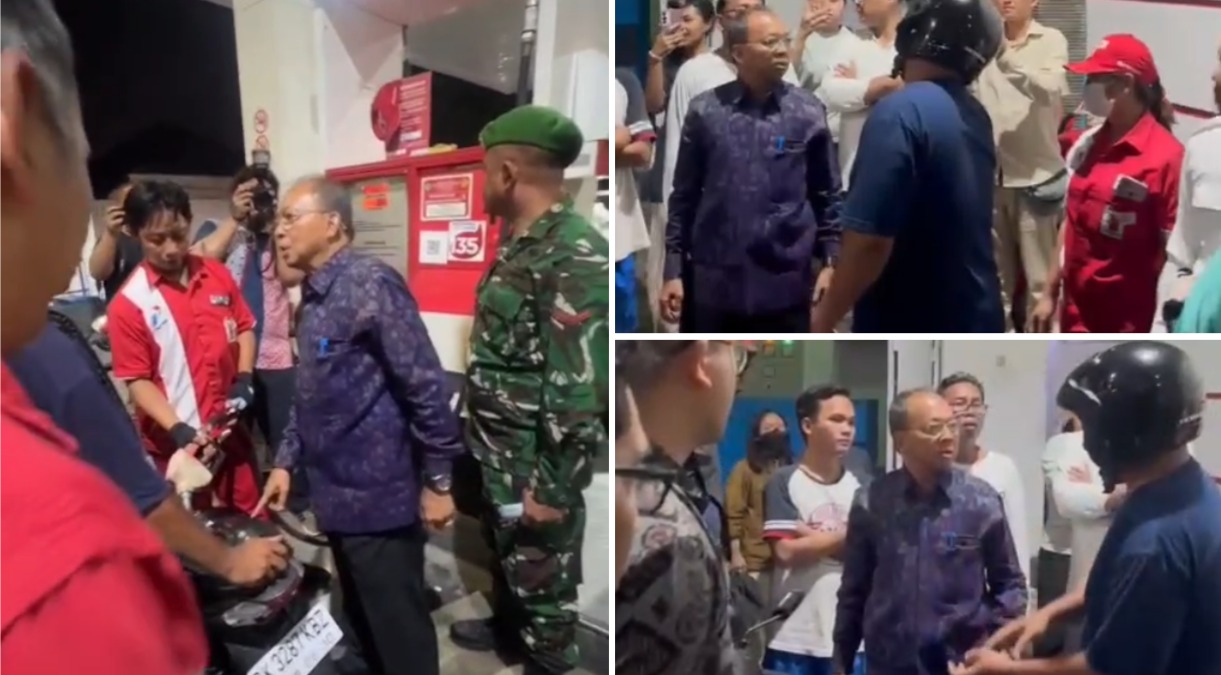
DENPASAR, BALINEWS – Long queues at fuel stations across Bali continued for a fourth consecutive day on Thursday, October 15, 2026, as disruptions to fuel distribution remained unresolved. Amid the situation, a video showing a gas station worker expressing exhaustion to Bali Governor Wayan Koster during his inspection of a fuel station on Jalan Pulau Komodo in Denpasar on Wednesday night went viral on social media.
In the video, a female employee is seen voicing her frustration over the workload faced by station staff amid the prolonged queues. Fighting back tears, she called for greater attention to the conditions of frontline workers who have been working extended hours to serve motorists.
“I am not a robot, sir,” she said.
The employee repeatedly expressed her exhaustion, saying, “I am tired, sir. I am tired.”
She also questioned whether the demands placed on fuel station workers were receiving sufficient attention, particularly as stations were expected to operate around the clock under a three-shift system. Koster appeared to listen to her complaints, while a man at the scene attempted to calm the situation.
The video prompted mixed reactions on social media and drew attention to the working conditions of fuel station employees as Bali continued to grapple with long queues and fuel distribution problems.
The Bali provincial government had previously encouraged work-from-home arrangements and online learning for students as part of its response to the situation. Fuel stations in several areas were also instructed to operate 24 hours a day to improve service and help reduce queues.
Despite these measures, long lines of vehicles continued to form at several stations, raising questions about the effectiveness of efforts to restore fuel supplies and distribution across the island.
Koster had previously asked Pertamina Patra Niaga officials to explain the long queues and improve fuel supply and distribution. Pertamina attributed part of the disruption to technical problems involving a fuel-carrying vessel during unloading operations. The company said it would accelerate deliveries and optimize fuel station operations, including extending operating hours to 24 hours in several areas.
Koster had also urged residents not to panic, saying fuel supplies were available despite distribution bottlenecks between depots and fuel stations.
Consumer Protection Group Calls for Pertamina Executives to Be Removed
Amid the continuing queues, I Putu Armaya, director of the Bali Consumer Protection Foundation (YLPK Bali), called for the removal of PT Pertamina (Persero) President Director Simon Aloysius Mantiri and the general manager of Pertamina Patra Niaga for the East Java–Bali region.
Armaya argued that explanations citing technical problems with fuel vessels and increased consumption of subsidized Pertalite gasoline were insufficient to address the difficulties faced by residents.
“Whatever the cause, the public must not continue to suffer because of poor service and disruptions to fuel distribution. If corrective measures have already been taken, why are people still having to queue for hours? Why has the problem not been resolved in a tangible way?” he said.
According to Armaya, the reported technical problems should prompt a comprehensive review of backup vessel availability, reserve stocks, emergency response measures, and coordination throughout the distribution network.
He also urged Pertamina to disclose information on fuel inventories, vessel arrival schedules, actual deliveries to fuel stations, and areas still experiencing shortages.
Armaya stressed that increased consumption of subsidized Pertalite should not be used to blame consumers without transparent data to support the claim.
“For the public, fuel is not merely a commodity. It is essential for working, attending school, running businesses, transporting goods, serving tourists, and keeping Bali’s economy moving,” he said.
He added that queues lasting several hours could result in lost productive time, reduced income, delayed work, and increased traffic risks on public roads.
Five Demands to Pertamina and the Government
YLPK Bali outlined five demands aimed at addressing the fuel distribution crisis.
First, Pertamina must restore supplies as quickly as possible and ensure effective distribution throughout Bali. Second, the company should disclose transparent information about fuel stocks, vessel arrival schedules, and actual deliveries to fuel stations.
Third, YLPK called for a comprehensive audit of fuel distribution management, including vessel readiness, reserve stocks, and contingency plans for supply disruptions.
Fourth, local governments, police, and relevant agencies should take steps to protect consumers from the consequences of long queues. Traffic management measures, including an odd-even vehicle restriction scheme, could be considered if field assessments show that such measures are necessary, proportionate, and legally authorized.
Fifth, YLPK urged the authorities and Pertamina to assess consumer losses and establish a complaint mechanism. Remedies or compensation should be considered where losses can be substantiated and the relevant legal requirements for liability are met.
Armaya also cited Indonesia’s Law No. 8 of 1999 on Consumer Protection. Article 4 establishes consumer rights, including the right to comfort, security, safety, and accurate information. Article 7 sets out business operators’ obligations to provide accurate, clear, and honest information, while Article 19 addresses compensation for losses in accordance with applicable legal provisions.
He noted that applying these provisions to losses resulting from fuel distribution disruptions would require an assessment of the facts, the causal relationship, the nature of the losses, and the relevant legal requirements.
YLPK Bali urged Pertamina, the central government, the Bali provincial administration, regency and municipal governments, and relevant supervisory agencies to take swift, transparent, and measurable action to restore fuel distribution.
As of publication, long queues remained a major public concern. Further clarification from Pertamina regarding the progress of supply recovery, as well as the company’s response to YLPK Bali’s demands, is needed to provide a fuller picture of efforts to resolve the fuel crisis in Bali.