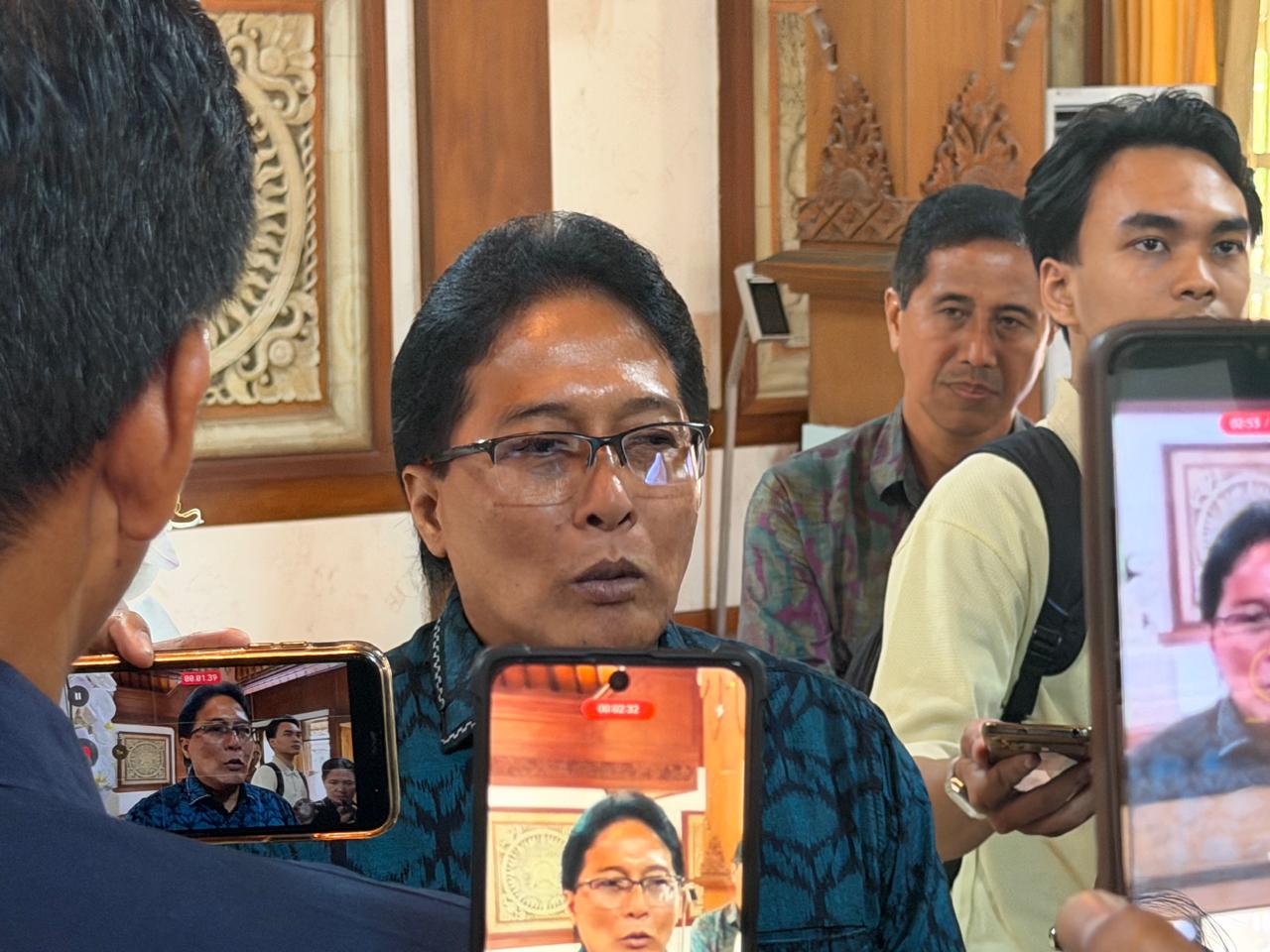
DENPASAR, BALINEWS — Bali Deputy Governor I Nyoman Giri Prasta has called for closer coordination between the central government, provincial administration, regency and municipal governments, and village authorities to address potholes and improve road infrastructure across the island.
Giri Prasta made the statement after attending the 55th Plenary Session of the Bali Provincial Regional House of Representatives (DPRD) on Monday, October 26, 2026. The session included discussions on the general views of DPRD factions regarding the proposed 2027 Regional Revenue and Expenditure Budget (RAPBD).
He explained that Bali’s road network consists of national roads, provincial roads, regency and municipal roads, local neighborhood roads, alleys, and roads developed through agreements between relevant parties. Each category falls under different management responsibilities, making coordination essential to ensure that repairs are carried out effectively.
As examples, Giri Prasta cited the Gilimanuk–Nusa Dua route as a national road, while the Sangeh–Petang and Sangeh–Mambal routes are examples of provincial roads.
According to him, road repairs cannot be handled in isolation if the government is to maintain connectivity between different areas. Cooperation across levels of government is therefore necessary, particularly for the development and maintenance of infrastructure connecting multiple jurisdictions.
“When I was a regent, we built provincial roads. Once the work was completed, we balanced it with other efforts. That is what synergy means,” Giri Prasta said.
Giri Prasta said the Bali Provincial Government had allocated maintenance funding through the agency responsible for public works and spatial planning (PUPR).
The provincial government also provides infrastructure support for development programs in regencies, municipalities, and villages. Such assistance can include coordination between neighboring areas, including projects connecting one village with another.
He emphasized that village infrastructure deserves particular attention because villages are at the forefront of public service delivery. Adequate infrastructure is essential for supporting residents’ daily activities, improving accessibility, and developing local economic potential.
Beyond physical development, Giri Prasta highlighted the importance of strengthening human resources at the village level to ensure that infrastructure investments generate sustainable benefits for local communities.
Giri Prasta also highlighted the implementation of the One Island, One Management, One Command concept in Bali’s development planning.
The approach emphasizes integrated governance, coordinated policies, and a unified direction for development across the island, rather than allowing infrastructure projects to proceed independently in each area.
He said Bali’s development should be planned holistically, taking into account infrastructure needs, regional potential, and the capacity of village-level human resources.
Through stronger coordination among the central government, provincial administration, regency and municipal governments, and village authorities, road repairs and infrastructure development are expected to become better aligned with local needs and the responsibilities of each level of government.
The provincial government’s approach places particular emphasis on cooperation across administrative boundaries to improve connectivity and support development throughout Bali.