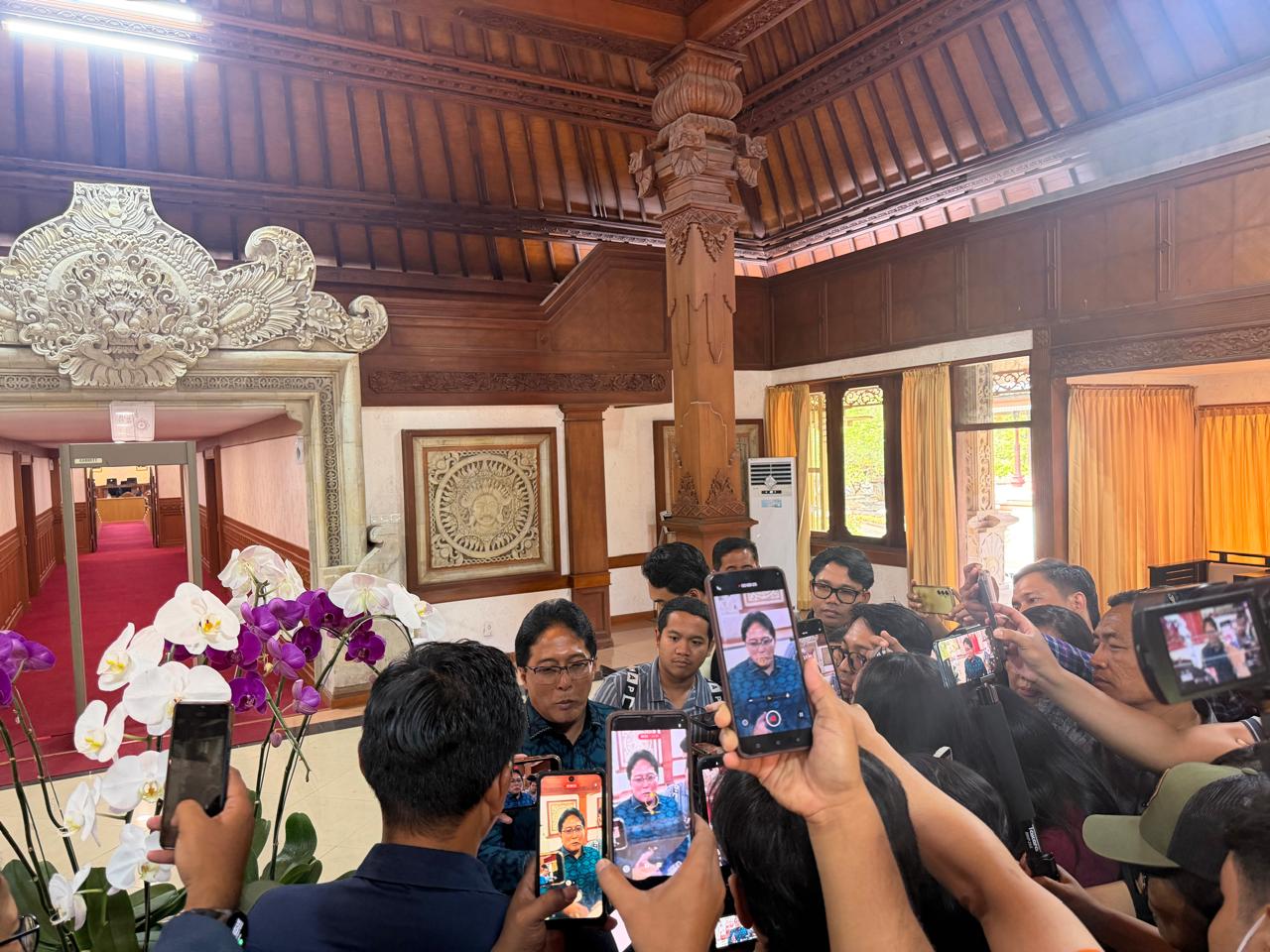
DENPASAR, BALINEWS — Bali Deputy Governor I Nyoman Giri Prasta has explained why he has not always been seen accompanying Governor Wayan Koster during on-site inspections of fuel stations amid a fuel supply crisis that recently triggered long queues at several gas stations across Bali.
Speaking after attending the 55th Plenary Session of the Bali Provincial Regional House of Representatives (DPRD) on Monday (October 26, 2026), Giri Prasta said the division of responsibilities between the governor and deputy governor had been established from the outset. He emphasized that he carries out government and community-related duties in accordance with Koster’s instructions.
“When it comes to the division of responsibilities, we have been given directions by the governor,” Giri Prasta said.
He explained that, as deputy governor, he must perform his duties within the scope of his authority and the assignments given to him. Consequently, he is not required to accompany Koster at every field inspection.
Giri Prasta also stressed the importance of coordination across all levels of regional government, from the provincial administration to regencies and municipalities, to ensure that government programs are implemented in a coordinated manner.
He reaffirmed his full support for the governor’s vision and mission, adding that the deputy governor must respect the limits of his authority.
Giri Prasta also revealed details of the initial response to Bali’s fuel supply crisis, saying he had accompanied Koster at the first meeting convened to discuss the issue.
According to Giri Prasta, representatives from state-owned energy company Pertamina and the oil and gas sector assured officials that the supply problem would soon be resolved.
“At the first meeting, I accompanied the governor. Pertamina and the oil and gas representatives said, ‘It’s okay, everything will be sorted out by tomorrow.’ The governor then conveyed the same message,” he said.
However, the situation on the ground did not match the assurances given during the meeting. Giri Prasta said the information received by the provincial government had not reflected the actual conditions.
“Our governor was basically pranked at the time. It turned out things were not as they had been presented,” he said.
His remarks offered an explanation for why the fuel supply problem continued despite having been discussed at an early stage, eventually leading to queues at several fuel stations.
The comments were Giri Prasta’s account of the events. The assurances he described had not been independently verified in the information provided.
To prevent similar disruptions in the future, Giri Prasta proposed considering the establishment of additional fuel storage depot capacity in Bali.
He said the provincial government needed comprehensive data from Pertamina Patra Niaga on the distribution of diesel, other fuel products and subsidized 3-kilogram liquefied petroleum gas (LPG) cylinders.
Such information, he said, would help authorities assess supply conditions and ensure that residents’ essential energy needs were met.
Giri Prasta also highlighted the importance of coordination with the central government, noting that the downstream oil and gas sector falls under the regulatory framework overseen by the Downstream Oil and Gas Regulatory Agency (BPH Migas).
In addition to fuel and LPG availability, he said the government needed to anticipate potential electricity supply disruptions and take measures to prevent rolling blackouts or widespread power outages.
He emphasized that addressing these risks required coordination among relevant institutions, supported by accurate data and timely assessments of actual supply conditions.
Addressing questions about his working relationship with Koster, Giri Prasta said he had been assigned to attend various engagements, including meetings at the central government level and activities involving community and customary affairs.
He described the division of responsibilities as part of effective regional governance, with each official expected to operate within their respective authority.
“As deputy governor, I fully understand that I serve as the governor’s deputy. There is no separate vision and mission for the deputy governor; the vision and mission belong to the governor, and we fully support them,” he said.
Giri Prasta expressed hope that cooperation between the governor and deputy governor, as well as among the provincial, regency, municipal and village administrations, would remain strong in implementing development programs and delivering public services.
He added that coordination across government levels was essential to ensuring the availability of basic necessities, including fuel, LPG and electricity, while improving preparedness for potential supply disruptions.