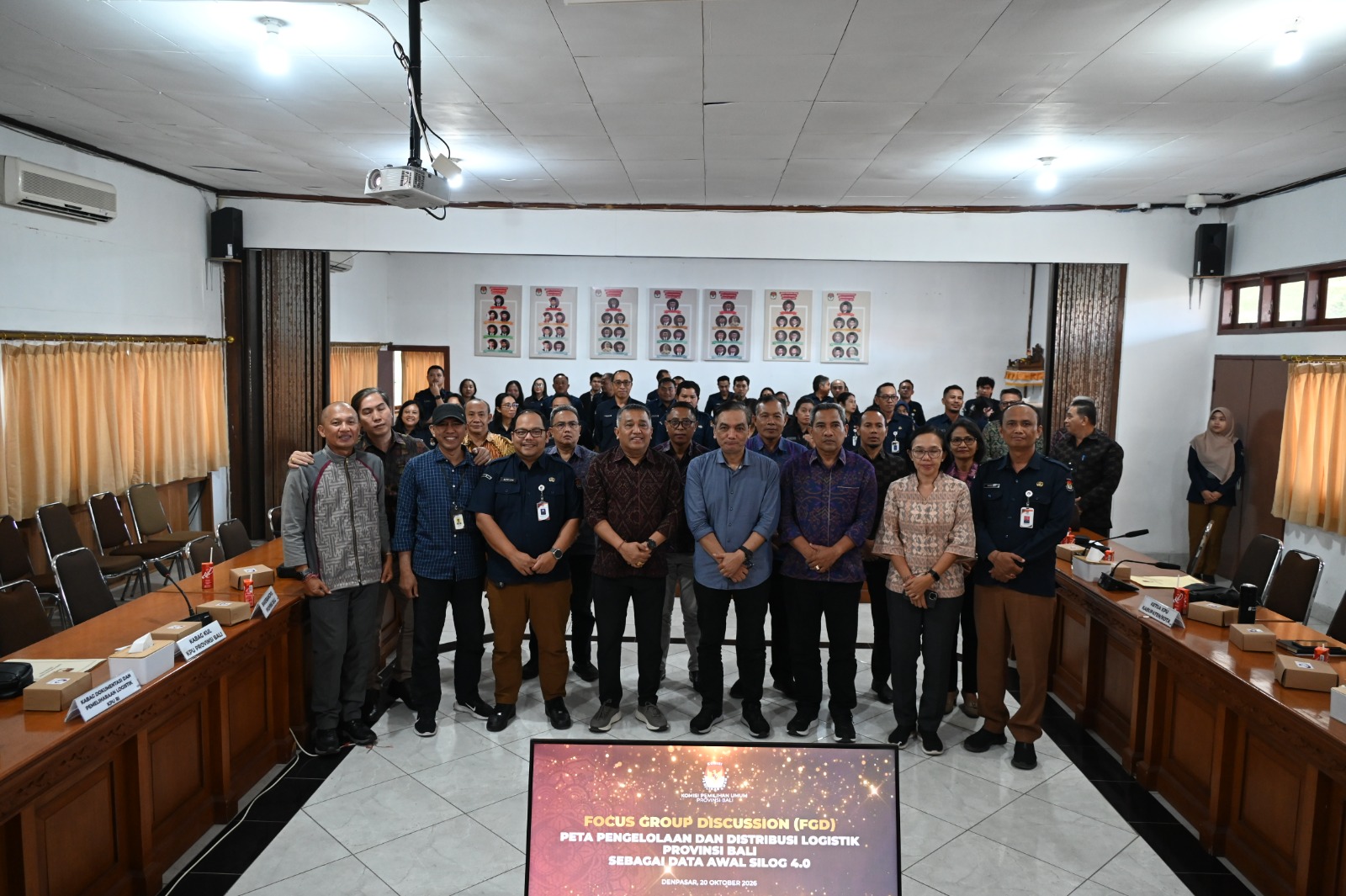
DENPASAR, BALINEWS – The Bali Provincial General Elections Commission (KPU Bali) is mapping logistics distribution routes, vehicle requirements, transportation costs, and inter-island ferry crossings as part of the initial data preparation for the development of Logistics Information System (SILOG) 4.0. The initiative was discussed during a Focus Group Discussion (FGD) held at the KPU Bali Provincial Office on Tuesday, October 20, 2026.
KPU Bali Chairperson I Dewa Agung Gede Lidartawan said the initial data had been prepared based on experience from the 2024 simultaneous general and regional elections. The data covers the receipt, storage, distribution, return, and disposal of election logistics.
KPU Bali has also mapped delivery routes and destination sequences across regencies and municipalities, along with vehicle requirements, estimated transportation costs, and inter-island crossing needs. The mapping is intended to support more measurable distribution planning tailored to the geographical conditions and logistical needs of each area.
Indonesian General Elections Commission (KPU RI) member Yulianto Sudrajat welcomed KPU Bali’s initiative to prepare logistics data and distribution maps to support the development of SILOG 4.0. He emphasized that election logistics management must ensure the right quantities, the right types, and timely delivery.
According to Yulianto, lessons learned from the 2024 simultaneous general and regional elections should serve as the foundation for developing a more professional, modern, and integrated logistics management system.
During the FGD, Adrian Aditya Nagara, Head of the Logistics Documentation and Maintenance Division, and KPU RI expert Ikhwanudin discussed ways to strengthen logistics needs planning, inventory management, and distribution risk mitigation.
The discussion also highlighted the importance of data validation at every stage of logistics management, from receipt, sorting, folding, and packing to distribution. Any discrepancies in logistics quantities must be traced through proper records and inspections to ensure that shortages can be addressed accurately and accounted for transparently.
Distribution planning also needs to take into account geographical data, travel distances, vehicle requirements, estimated travel times, and areas requiring special handling. Standardized procedures, improved warehouse management, and enhanced human resource competencies were also identified as important components of the SILOG 4.0 development process.
Through the FGD, KPU Bali expects the initial data and distribution maps to provide meaningful input for the development of SILOG 4.0. The integrated system is expected to improve operational efficiency, preserve institutional knowledge and data continuity, and strengthen accountability in election logistics management across all levels of the KPU.
The initiative forms part of KPU Bali’s efforts to support more professional election administration and ensure that voters’ needs are properly met.