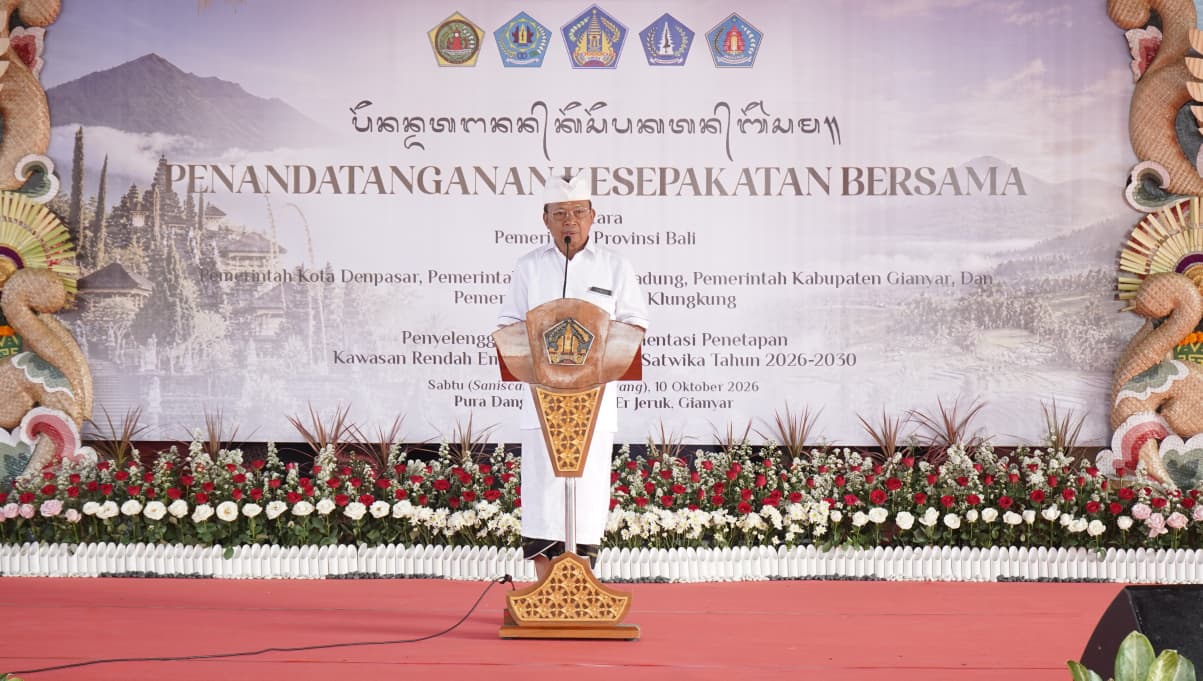
DENPASAR, BALINEWS — Bali Governor Wayan Koster has designated six areas across Bali as Low-Emission Zones under the Kerthi Bhumi Satwika initiative, aimed at reducing greenhouse gas emissions and promoting sustainable development. The program will run from 2026 to 2030.
The six designated areas are Ubud, the Nusa Penida Islands, Nusa Dua, Kuta, Sanur, and the Gajah Mada Cultural Heritage Area in Denpasar.
The designation is stipulated in Bali Governor’s Decree No. 912/04-B/HK/2026, issued on Tuesday, October 6, 2026. The policy was formally announced on Saturday, October 10, 2026, coinciding with Tumpek Wayang, a sacred day in the Balinese Hindu calendar.
The Kerthi Bhumi Satwika initiative is designed to integrate spatial planning and cross-sectoral programs to reduce greenhouse gas emissions, accelerate the adoption of clean energy, promote environmentally friendly transportation, and protect ecosystems and biodiversity.
Implementation will involve the Bali Provincial Government in coordination with the governments of Gianyar Regency, Klungkung Regency, Badung Regency, and Denpasar City. Each local government will develop programs tailored to its regional characteristics, local potential, and fiscal capacity.
The initiative is built around five strategic pillars: green energy, green transportation, green ecosystems, green tourism industries, and green communities.
In the energy sector, the program aims to accelerate the use of new and renewable energy sources and improve energy efficiency. In transportation, the focus will be on developing battery-powered electric vehicles and supporting infrastructure for environmentally friendly mobility.
Environmental measures will include forest rehabilitation, the expansion of urban green spaces, the protection of coastal areas and marine ecosystems, and stronger waste management at the source, alongside the development of a circular economy.
The tourism sector will be encouraged to adopt environmentally responsible practices, reduce the use of single-use plastics, and develop culturally rooted and sustainable destinations.
Implementation will be tailored to the specific characteristics of each designated area. Ubud will focus on strengthening culture- and environment-based tourism, while the Nusa Penida Islands will prioritize the sustainability of island and coastal ecosystems.
Nusa Dua, Kuta, and Sanur will serve as strategic areas for promoting environmentally friendly tourism practices. Meanwhile, the Gajah Mada Cultural Heritage Area in Denpasar will focus on integrating the preservation of historic sites with sustainable urban development.
The Bali Provincial Government will strengthen coordination and policy alignment with regency and city administrations. Implementation will also require collaboration among government agencies, tourism businesses, traditional villages, community groups, universities, research institutions, and the wider public.
The Kerthi Bhumi Satwika initiative will undergo periodic evaluations to assess progress, identify implementation challenges, and determine corrective measures. These evaluations are intended to ensure the program's effectiveness and deliver tangible improvements in emissions reduction and environmental quality.
Through this policy, the Bali Provincial Government aims to balance economic growth and tourism development with environmental protection and the long-term well-being of local communities.