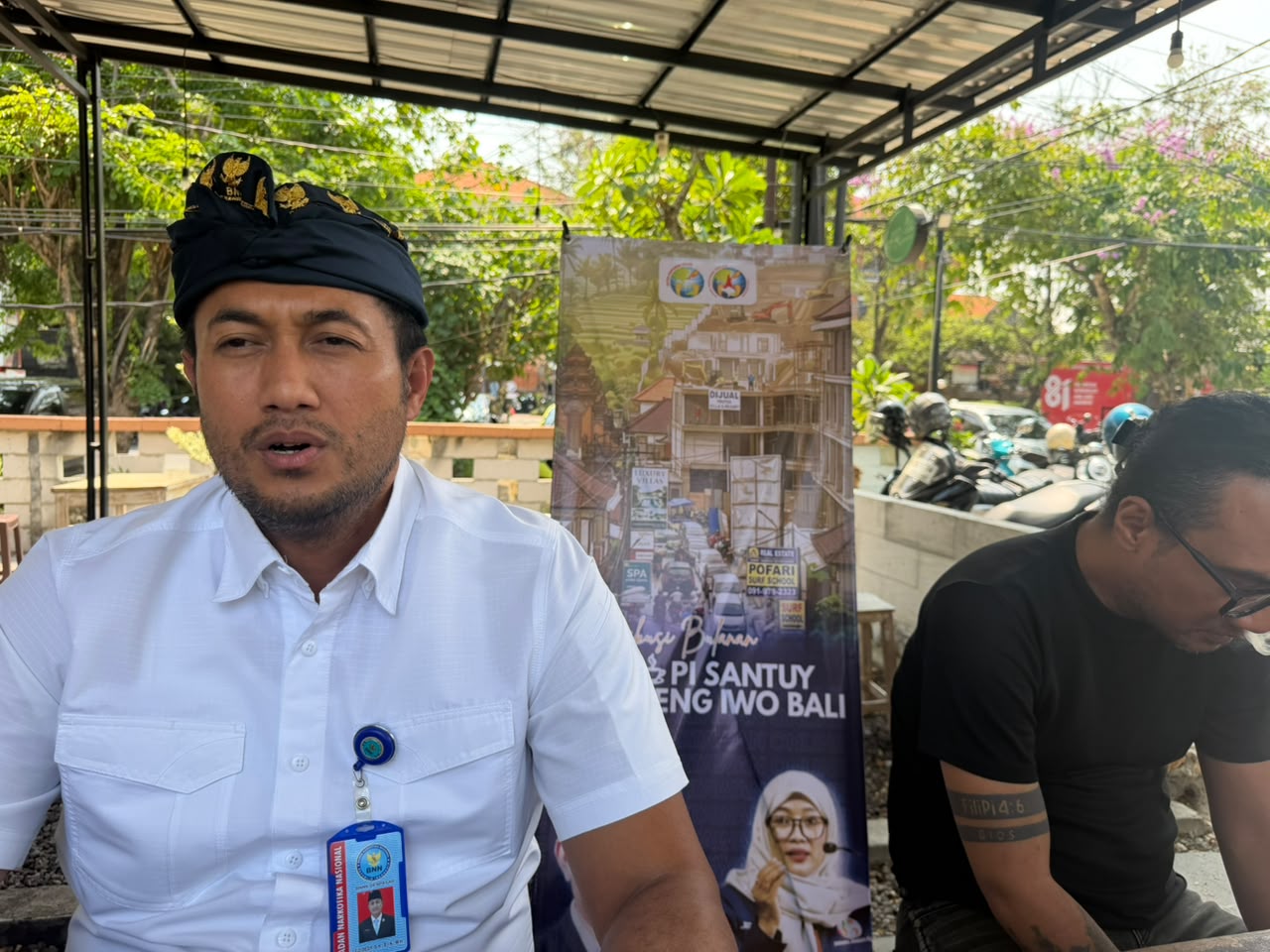
DENPASAR, BALINEWS — The Denpasar City National Narcotics Agency (BNN) has identified Pemogan and Pemecutan Kelod as areas with a high level of vulnerability to illicit drug distribution. Both areas have been classified as red zones based on the narcotics vulnerability index used by the agency.
Head of the Denpasar City BNN, Commissioner Dr. Leo Dedy Defretes, S.H., S.I.K., M.H., said other areas across Denpasar remain in the alert category.
“Based on the narcotics distribution vulnerability index, Pemogan and Pemecutan Kelod are classified as red zones, while the other areas remain in the alert category,” Leo said during the monthly Ngopi Santuy discussion organized by the Bali chapter of the Online Journalists Association (IWO) in Renon, Denpasar, on Wednesday (September 30, 2026).
According to Leo, the vulnerability assessment is consistent with the relatively high number of drug-related cases uncovered in Denpasar. He said Denpasar is among the areas in Bali with a high number of drug cases uncovered by authorities.
“Looking at the number of drug distribution cases uncovered in Bali, Denpasar is among the highest, including in the two villages classified as red zones,” he said.
BNN Strengthens Intervention in High-Risk Areas
The Denpasar City BNN is not relying solely on law enforcement measures to address drug-related problems. Direct community intervention is also being carried out in areas identified as having higher levels of vulnerability.
Leo said one of the approaches involves community empowerment through life-skills training. The program is intended to strengthen residents’ capacity while encouraging activities that can support their livelihoods.
“We continue to intervene directly in the community through empowerment activities and by improving people’s life skills,” he said.
In addition to community empowerment, the BNN conducts area mapping and joint inspections with relevant agencies and stakeholders.
Traditional Villages Involved in Prevention Efforts
Prevention efforts are also being expanded through cooperation with traditional villages (desa adat).
The Denpasar BNN is encouraging traditional villages to strengthen local regulations through pararem, a form of customary rule, as part of efforts to create an environment that is better protected from illicit drug distribution.
Leo said community involvement is essential to limiting the space available for drug distribution at the neighborhood level.
“We also conduct mapping, joint inspections and work together with traditional villages,” he said.
The measures form part of the Denpasar BNN’s strategy to address areas with higher levels of vulnerability while strengthening community-based prevention.
43 Villages and Urban Villages Targeted for “Drug-Free” Status
In addition to giving special attention to the two red-zone areas, the Denpasar City BNN is encouraging all 43 villages and urban villages in Denpasar to become Bersinar areas — an acronym for Bersih dari Narkoba, or “Drug-Free.”
The program is designed to establish a prevention system involving local government, communities, traditional villages, schools, families and various community groups.
The BNN considers a community-based approach necessary to ensure that prevention does not begin only after drug-related cases occur, but also works to reduce the potential for illicit drug distribution at the neighborhood level.
The Ngopi Santuy discussion was attended by IWO Bali Chairwoman Tri Widiyanti and members of the Bali provincial executive board. Also present were Denpasar IWO branch chairman Bambang Supriyono, Denpasar IWO branch secretary Kande Putra, and Badung IWO branch chairman Rovinus Bou, along with other administrators and members.