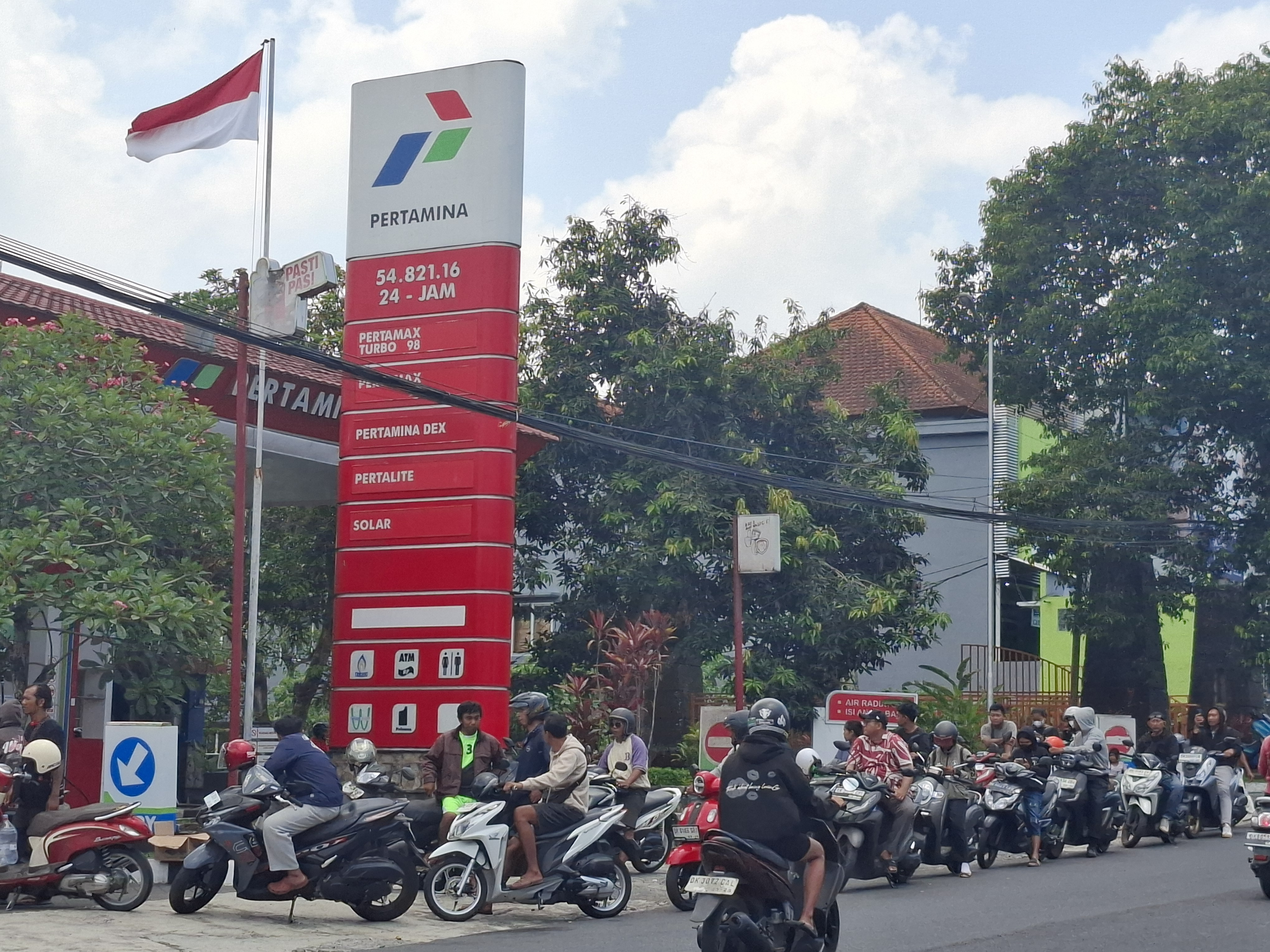
DENPASAR, BALINEWS — Long queues at several fuel stations in Denpasar, Bali, have triggered severe traffic congestion, disrupting daily activities and tourism transportation services. Queues at some locations reportedly stretched for approximately one kilometer.
Bali tourism operator Bli Kande reported the situation after monitoring traffic conditions in several parts of Denpasar from around 7:30 a.m. local time on Tuesday, October 13, 2026. He found heavy congestion caused by vehicles lining up to refuel.
In the Gatot Subroto Tengah area, traffic was heavily congested from a fuel station near Jalan Ahmad Yani toward the Ubung intersection. Similar conditions were observed near Lumintang Field, where vehicles waiting to refuel occupied two lanes, with the queue extending toward the KFC area.
Long queues were also seen in Renon, near the National Land Agency (BPN) office. Vehicles waiting for fuel formed a winding line extending toward Jalan Badak Agung.
Congestion was also reported near a fuel station in the BTP area and around Stikom. The queue at the station near Stikom reportedly caused traffic to back up as far as the Bajra Sandhi traffic light.
“Interestingly, Pertalite had already run out at the fuel station in Gatot Subroto Tengah. There was a notice announcing that Pertalite was unavailable, but people were still queuing to get Pertamax,” Kande said.
According to Kande, the situation has fueled public frustration, as motorists have had to spend considerable time on the road simply to obtain fuel.
Although some residents expressed their dissatisfaction with a smile or through sarcastic remarks, many were clearly upset by the long queues and resulting delays.
Kande recalled one resident making a frustrated remark that, given the choice, he would rather have been born in the United States or the United Kingdom than in Indonesia.
As a tourism operator, Kande said the problem was not merely about the type or price of fuel, but also its availability. The situation has directly affected public mobility and the delivery of tourism services.
He said some residents were willing to pay more for Pertamax, a higher-priced fuel option, as long as fuel remained available and could be obtained without excessive waiting times.
“The problem is not whether it is Pertalite or Pertamax. The problem is being able to get fuel at all. People are queuing because they need it,” he said, recounting comments from residents he interviewed.
Kande added that some people had even said they would not mind an additional Rp10,000 on the price of Pertalite if it meant fuel would remain available.
The queues have also made travel times increasingly difficult to predict, creating challenges for tourism operators responsible for transporting visitors between destinations.
Under normal conditions, a journey from Kuta to Ubud would typically take around 40 minutes to one hour, Kande said. However, traffic congestion caused by fuel queues has made travel times far less predictable.
Tour operators are consequently finding it harder to arrange pickup schedules and plan tourist itineraries, particularly when congestion affects major routes.
“In the past, we could estimate that a trip from Kuta to Ubud would take around 40 minutes to an hour. Now, with conditions like these, we cannot predict how long the journey will take because fuel queues are causing traffic congestion in several areas,” he said.
Kande expressed disappointment over the situation, emphasizing that reliable transportation is essential to Bali’s tourism industry.
He said one of his scheduled tourist departures on Tuesday morning had been delayed by approximately four hours because he first had to find fuel and wait in line to refuel.
Despite the delay, he confirmed that none of the tourists under his care had canceled their trip. The journey eventually proceeded after he secured fuel.
The situation highlights how fuel availability problems and long queues at filling stations can affect not only motorists but also tourism transportation services, an essential part of Bali’s tourism sector.