BOGOR, BALINEWS — Indonesia’s Coordinating Ministry for Human Development and Cultural Affairs (Kemenko PMK) is accelerating efforts to develop a National Action Plan for a Lead-Free Indonesia for 2027–2029, alongside a long-term roadmap for 2030–2045.
The government is emphasizing cross-sector collaboration to address exposure to lead, which can originate from a wide range of sources, including lead-acid batteries, industrial activities, paint, consumer products, food, water, medicines, household products and contaminated sites.
Jelsi Natalia Marampa, Assistant Deputy for Nutrition Improvement and Stunting Prevention at Kemenko PMK, said efforts to control lead exposure cannot be handled by a single ministry or sector because its sources and pathways span multiple areas.
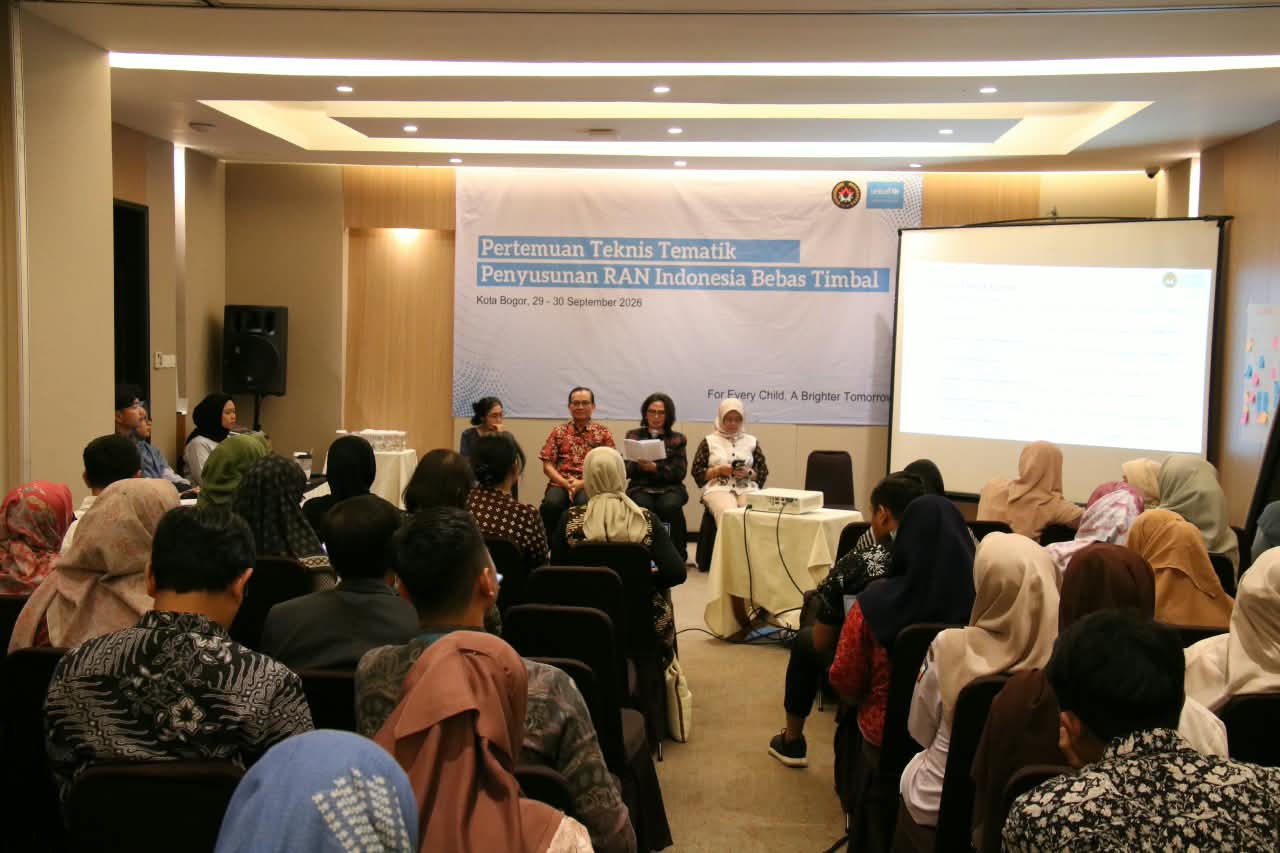
She made the remarks while representing Kemenko PMK Deputy for Health Quality Improvement Coordination Sukadiono at a thematic technical meeting on the National Action Plan for a Lead-Free Indonesia 2027–2029 and the 2030–2045 Roadmap, held jointly by Kemenko PMK and UNICEF at Hotel Santika Bogor on Sept. 29–30, 2026.
“We see that the sources of exposure involve many stakeholders and sectors. That is why, together with UNICEF, we have invited everyone to work together to formulate and implement the measures needed to control lead exposure on the path toward a Lead-Free Indonesia,” Jelsi said.
She said effective control would require strong coordination and a clear division of responsibilities among the central and local governments, civil society organizations, academics, businesses and development partners.
“Lead exposure cannot be controlled by one ministry or one sector alone. It requires strong coordination and a clear division of roles among the central and local governments, civil society, academics, businesses and development partners,” she said.
The technical meeting followed a high-level policy meeting on the goal of a Lead-Free Indonesia by 2045, organized by Kemenko PMK on Sept. 24, 2026.
The earlier meeting focused on building a common commitment, establishing an initial framework and identifying key needs for addressing lead exposure in Indonesia. The latest technical forum was aimed at translating those policy directions into specific, measurable and implementable actions for the 2027–2029 period.
The discussions brought together representatives from ministries and government agencies, national technical institutions, local governments, civil society organizations, professional associations, academics, businesses, laboratories and development partners.
Over the two-day meeting, participants consolidated and validated available evidence, regulations, programs and data, while identifying capacity gaps across different areas of lead exposure control.
They also discussed priority actions, expected outputs, implementation stages, lead and supporting institutions, initial indicators and other requirements needed to implement the plan.
Participants were divided into four thematic groups covering lead-acid batteries, industry and workers; paint and non-food consumer products; food, water, medicines and household products; and contaminated hotspots and affected communities.
Each group examined proposed actions based on three dimensions: sources of exposure, response stages and system functions.
Cross-cutting areas included regulation and governance, data and surveillance, laboratory capacity, health services, human resources, financing, and public communication and participation.
In the health sector, discussions covered stronger surveillance systems, blood lead testing, medical management, referral networks and laboratory capacity.
From a governance and financing perspective, participants highlighted the need to integrate lead-related issues into planning, budgeting and program implementation at both the national and local levels.
On the second day, participants conducted a gallery walk to gather feedback across thematic groups before finalizing the initial action matrix. A plenary session then addressed cross-cutting issues, overlapping mandates and decisions requiring further coordination.
The meeting produced an initial framework for the 2027–2029 National Action Plan across the four thematic areas. It also identified requirements related to data, regulations, capacity, financing and coordination.
At the conclusion of the meeting, Jelsi said follow-up efforts would focus on strengthening regulatory harmonization, consolidating and monitoring data, and identifying gaps and challenges in controlling lead exposure.
The government will also refine priority actions for each thematic area and map the roles of ministries and government agencies, including lead and co-lead sectors, as well as local governments and development partners.
Kemenko PMK said monitoring and accountability mechanisms would be essential to ensure that the National Action Plan becomes more than a policy document and is translated into concrete and measurable action.
The process is expected to provide the foundation for the Lead-Free Indonesia Roadmap for 2030–2045, with the goal of establishing integrated control of lead exposure from upstream sources through to affected communities.
Kemenko PMK and its stakeholders are seeking to translate Indonesia’s commitment to becoming lead-free by 2045 into concrete, measurable and sustainable cross-sector action.