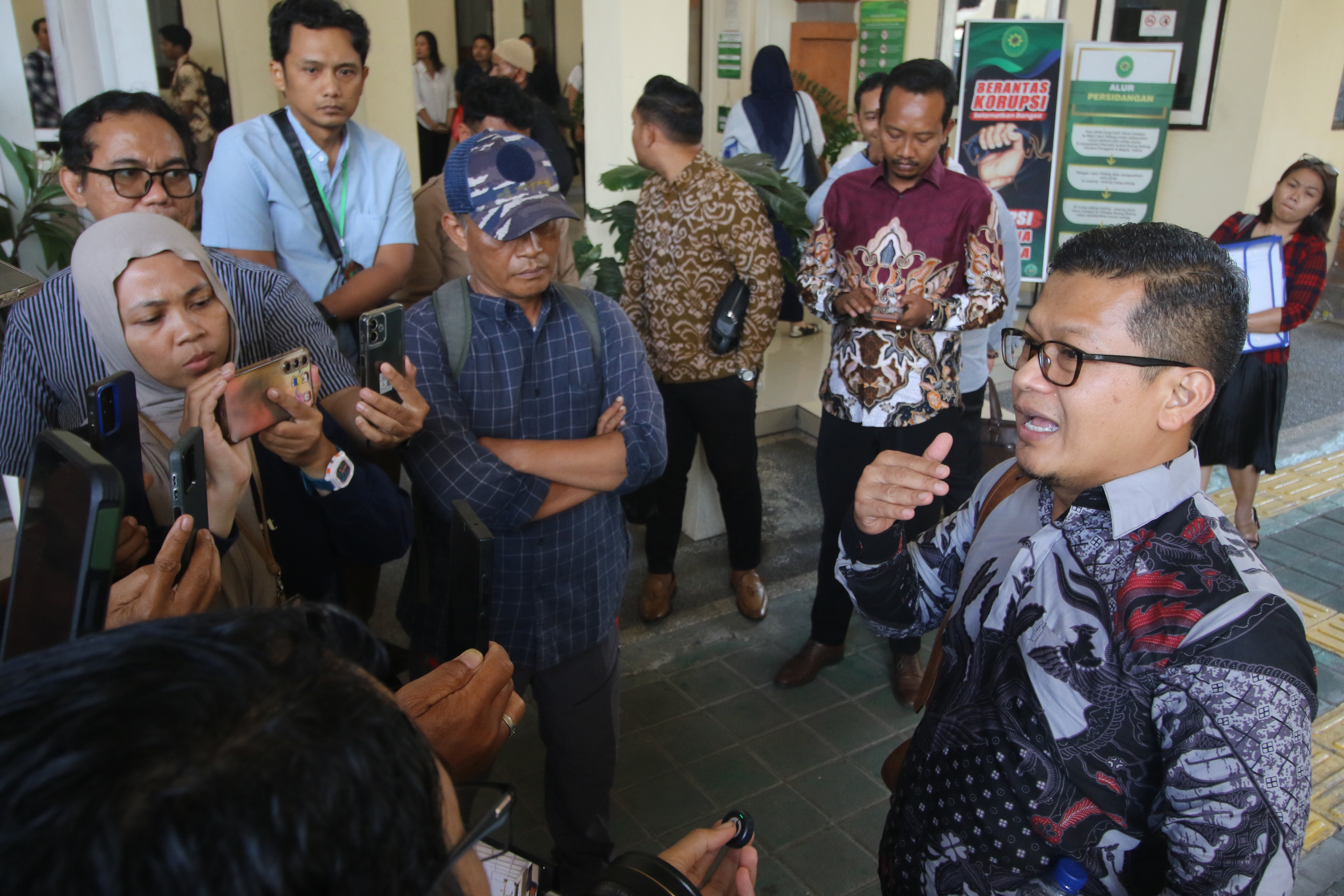
DENPASAR, BALINEWS — Disputes arising from journalistic products should first be resolved through the Press Council’s dispute-resolution mechanism before being brought before a court, a Press Council legal expert told the Denpasar District Court on Monday (Oct. 5, 2026).
Hendrayana, S.H., M.H., a press law and legislation expert with the Press Council, was called by the defendants as an expert witness in a Rp25 billion civil lawsuit filed by lawyer Togar Situmorang against four media companies in Bali.
The hearing was held at the Sari Courtroom of the Denpasar District Court. The panel of judges was chaired by Abang Marthen Bunga, S.H., M.Hum., with Yudi Eka Putra, S.H., M.H., and Theodora Usfunan, S.H., M.H., serving as associate judges.
In his testimony, Hendrayana emphasized the legal principle of lex specialis derogat legi generali in the resolution of press disputes. He said Law No. 40 of 1999 on the Press provides a specific mechanism for resolving disputes related to journalistic products.
“If a dispute over news coverage has not reached a final resolution through the Press Council mechanism, while the aggrieved party directly files a lawsuit in court, the lawsuit is procedurally considered premature,” Hendrayana told the court.
He explained that the press dispute-resolution mechanism essentially involves assessing whether a journalistic work complies with the Journalistic Code of Ethics. The assessment includes aspects such as verification, balance or the cover both sides principle, the presumption of innocence, and the substantive accuracy of the report.
According to Hendrayana, efforts by journalists to seek confirmation from parties mentioned in a report are an important part of the journalistic process. If a journalist has attempted to obtain confirmation but receives no response, the effort should still be considered as part of the overall journalistic process.
“If confirmation has been sought but no response is received, the journalist has fulfilled the ethical principle,” he said.
Hendrayana also highlighted the importance of the right-of-reply mechanism in resolving press disputes. If a media outlet has published a right of reply but the complainant remains dissatisfied with its implementation, he said the matter can be brought back to the Press Council for further review.
“The court is not the primary forum for assessing the effectiveness or compliance of a right of reply that is still within the ethical mediation process,” he said.
He said the mechanism is a consequence of the Press Law’s status as a special legal framework governing disputes arising from journalistic work.
Hendrayana further explained that not every dispute involving a media organization automatically constitutes a press dispute. It must first be determined whether the subject of the dispute is genuinely a journalistic product and whether the matter is related to the exercise of journalistic functions.
During the hearing, Hendrayana also outlined his experience in press law, which he has studied and practiced since 2006. He said he has provided expert testimony in judicial and police proceedings on 48 occasions.
His testimony was presented during the evidentiary stage of the Rp25 billion civil lawsuit, which remains under examination by the Denpasar District Court. The defendants also submitted documentary evidence and case-law materials from other cases they considered similar to the dispute.
Hendrayana reiterated that disputes over journalistic works should first be assessed from the perspective of journalistic ethics and through the dispute-resolution mechanisms provided under the Press Law.
The case remains under examination at the Denpasar District Court, and the panel of judges has yet to issue a ruling.