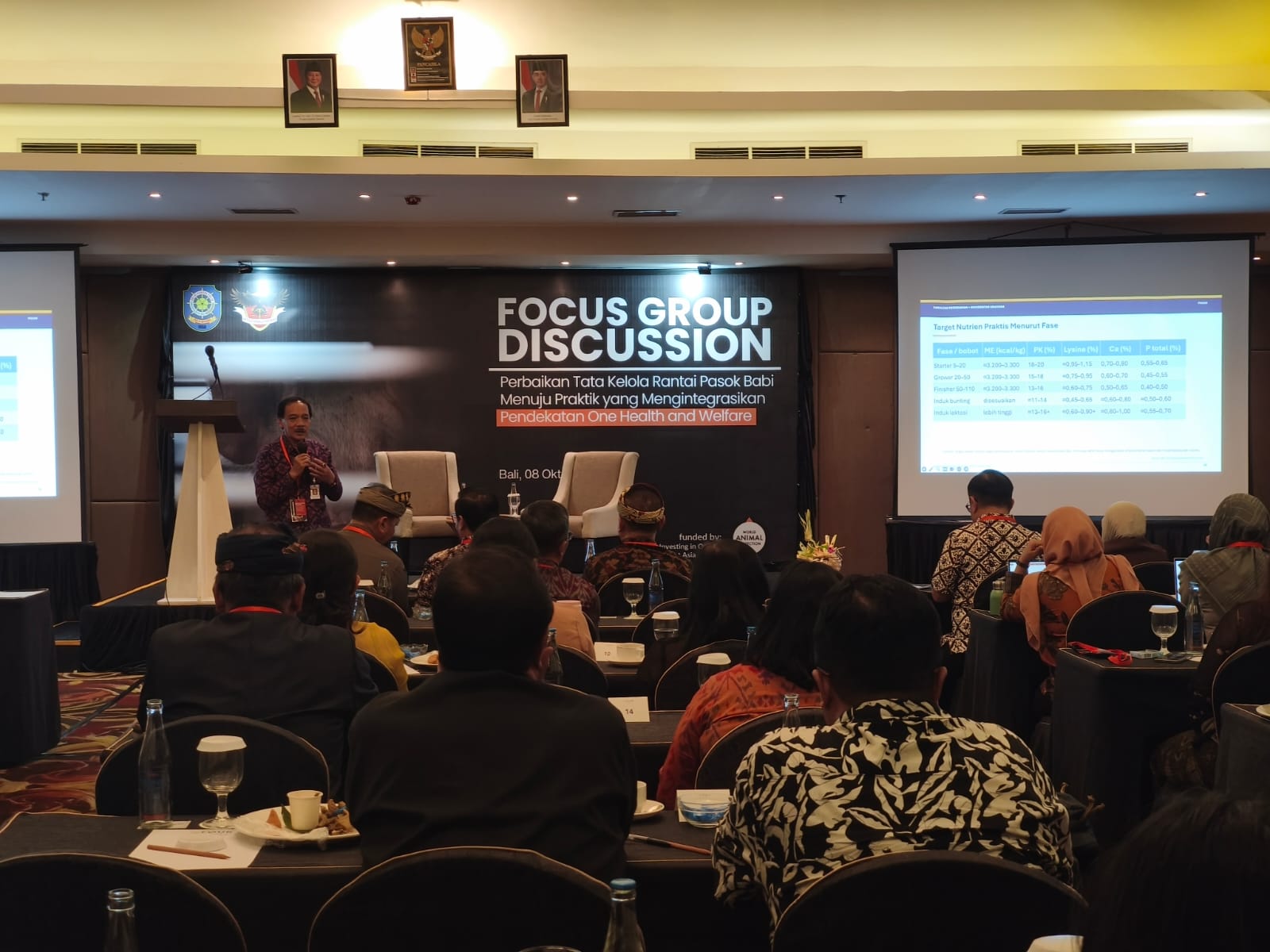
DENPASAR, BALINEWS — The Bali provincial government, through the Bali Public Order Agency (Satpol PP), has begun efforts to reform the island’s pig supply chain from farm to market in a bid to improve production quality and expand the absorption of locally raised pigs by the tourism industry.
The reform was discussed at a focus group discussion (FGD) titled “Improving Pig Supply Chain Governance Toward Practices Integrating the One Health and Welfare Approach” in Denpasar on Thursday (Oct. 8, 2026).
The forum brought together representatives from the Ministry of Agriculture, academics, pig farmers, industry associations, regency and municipal governments, as well as waste-management companies.
Bali Satpol PP Chief Dewa Nyoman Rai Dharmadi said the improvements would cover the entire pig production chain, including farming practices, housing conditions, slaughtering procedures, animal health, waste management and distribution.
“It covers how the pigs are raised, their housing, the slaughtering process itself, and the distribution,” Dharmadi said.
He said the reform was necessary given Bali’s significant pig production. Data from 2025 showed that Bali had a pig population of 433,481 head.
Between 2020 and 2025, Bali also accounted for between 39.5 percent and 61.7 percent of Indonesia’s national pork production.
However, the island’s large production has not been fully matched by its ability to meet market standards, particularly those required by the tourism industry.
Dharmadi said the quality of locally produced pork still needed to be improved to meet the standards required by hotels and restaurants. One of the issues was the slaughtering process.
He said improper slaughtering practices could cause pigs to become stressed, potentially affecting meat quality, including products such as babi guling, Bali’s traditional roasted pork dish.
At the same time, the tourism industry, particularly five-star hotels, requires meat suppliers to meet specific standards and certification requirements.
“Yes, certification. And when we talk about certification, we are talking about standards — the standards expected by hotels and restaurants,” he said.
Dharmadi said these market requirements could provide an opportunity for traditional pig farmers in Bali to improve the quality of their livestock and increase their economic well-being.
The opportunity could also grow amid restrictions or a ban on pork entering Bali from outside the island, which is expected to create greater market space for local farmers.
“This is certainly a prospect going forward so that traditional farmers can improve the quality of their livestock products and also improve their quality of life economically,” Dharmadi said.
Beyond production and certification, the supply chain reform will also address waste management in pig farming.
Poorly managed livestock waste can cause unpleasant odors and pollution and potentially affect public health and tourism activities, Dharmadi said.
“To address this, we cannot focus only on the downstream side. It also has to start upstream,” he said.
Dharmadi said livestock waste could be processed into useful products, including biogas.
Medium-scale farms, he said, must comply with existing waste-management regulations, while better waste-management practices would also be encouraged among traditional and household-scale farms.
The reform is also expected to involve customary villages in Bali. One proposal is the development of slaughterhouses that could involve companies with an interest in certification and pork quality.
The presence of slaughterhouses is also expected to support the economic independence of customary villages through local retribution revenue.
“We are encouraging customary villages to achieve greater independence, as well as economic independence for indigenous communities,” Dharmadi said.
Meanwhile, I Ketut Wirata, Director of Veterinary Public Health at the Directorate General of Livestock and Animal Health of the Ministry of Agriculture, said certification remained one of the challenges in increasing the absorption of Balinese pork by the hotel industry.
According to Wirata, the Veterinary Control Number (NKV) certification is an important component of the animal-product supply chain. For pork products, NKV certification applies to slaughterhouses, processing units and distribution chains.
“It is not that we are unable to compete. Rather, we have not yet been able to provide the specifications required by HOREKA,” Wirata said, referring to the hotel, restaurant and catering sector.
He said the tourism industry had specific requirements for meat quality and cuts, including premium cuts such as pork belly skin off.
Therefore, he said, improving the supply chain would require more than investment in infrastructure. Human resources capable of cutting and processing meat according to market specifications would also need to be developed.
“We are not only investing in infrastructure, but also in human resources. We need to provide training and develop butchers who can produce cuts according to the specifications required by HOREKA,” he said.
Wirata expressed hope that the improvements would enable Bali’s pig industry to meet not only local demand but also strengthen its position in its own home market.
“I hope this pig industry can become the host in Bali,” he said.
According to Wirata, Bali already has a strong foundation in the form of its large pig population. Better supply-chain management, he said, could further strengthen the island’s position in the pork supply chain.
He also expressed the hope that Bali could eventually become a benchmark for pork prices.
“Now we just need to build good governance. Then Bali could determine the price of pork per kilogram in the world. If we can achieve that, it would be extraordinary,” Wirata said.