DENPASAR, BALINEWS – The growing amount of time young people spend playing online games has become a serious concern for security authorities. Digital gaming platforms, while primarily intended for entertainment, can potentially be exploited by extremist groups to approach, influence, and indoctrinate children and teenagers with violent ideologies.
The issue was highlighted by the Bali Regional Task Force of Densus 88 (Indonesia's National Police Counterterrorism Special Detachment) during the 2026 Digital Literacy Seminar, themed “Empowering Communities to Maintain Security in Bali's Digital Space to Support Quality and Dignified Tourism.” The event was held at Ksirarnawa Building, Bali Cultural Park, Denpasar, on Thursday, October 29, 2026.
Head of the Bali Regional Task Force of Densus 88, Commissioner Yulianto Rombe Biantong, A.Md., S.H., explained that several online gaming platforms, including Roblox, require greater attention and parental supervision.
He emphasized that the potential danger does not necessarily lie in the games themselves, but rather in interactions between children and digital communities that may lead them into private or closed online groups.
"Playing games is not wrong, but we must pay close attention and ensure proper supervision," Yulianto stressed.
He explained that, in several patterns monitored by Densus 88, children who initially interact through online games may be invited to join private groups. Within these communication spaces, indoctrination can take place through repeated exposure to content depicting murder, violence, and graphic or sadistic material.
Repeated exposure to such content raises concerns that children may gradually become desensitized to violence and begin to perceive brutal acts as normal. Furthermore, children exposed to extremist material may be at risk of imitating violent behavior when facing bullying or conflicts with their peers.
Yulianto also warned about the use of certain symbols associated with extremist movements, including Nazi symbols, the Black Sun, White Power, and other related imagery.
Parents, he said, need to understand and recognize potential signs of extremist exposure without immediately labeling or stigmatizing their children.
Changes in children's everyday behavior should also be closely monitored. These may include withdrawing from social interactions, becoming excessively absorbed in digital devices, spending increasingly long periods using gadgets, and becoming easily irritated when their digital activities are interrupted.
"The most important factor is the role of the family. We always emphasize that family matters," he said.
He stressed that parental supervision cannot be fully replaced by restrictions on gadget use imposed by schools. Families are the first environment capable of identifying behavioral changes and providing the necessary guidance and support.
Yulianto also revealed that during school outreach activities, Densus 88 had encountered children who admitted to previously joining groups suspected of spreading extremist ideologies.
In handling such cases, Densus 88 prioritizes guidance, mentoring, assessment, and rehabilitation for children exposed to extremist influences. These measures take into account the children's age and future prospects, rather than relying solely on law enforcement measures.
"We will not pursue law enforcement measures against them because they are still children. Why? Because they still have a future. We seek to provide assistance, guidance, and even rehabilitation," he explained.
110 Children Identified as Having Been Recruited Online
The threat of recruiting children through digital platforms is not merely a theoretical concern.
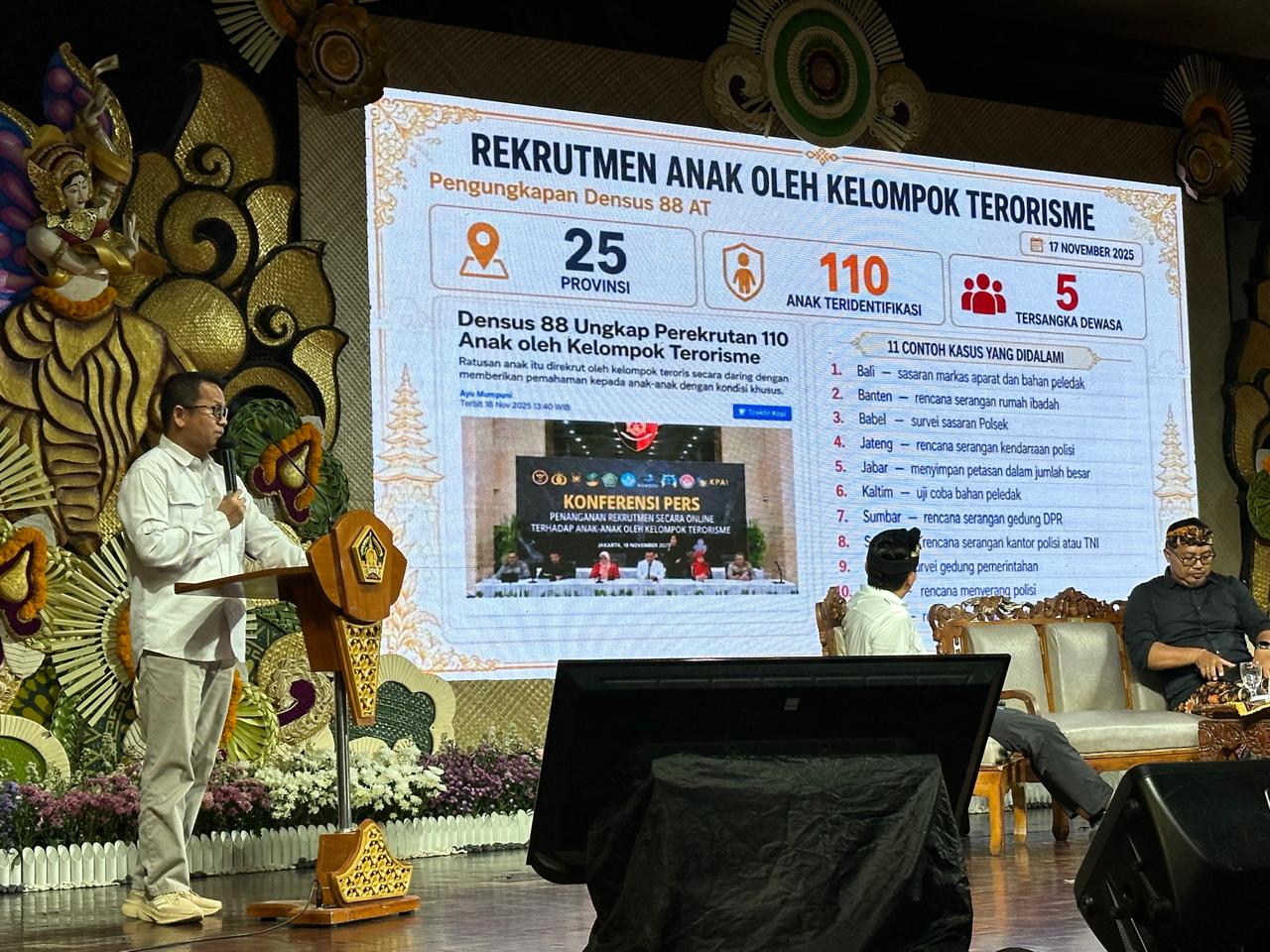
According to an investigation disclosed by Densus 88 on November 17, 2025, a total of 110 children were identified as having been recruited online by terrorist groups across 25 provinces in Indonesia. In connection with the investigation, five adults were also named as suspects.
Several cases examined by authorities reportedly involved alleged plans for violent attacks targeting security force facilities, houses of worship, and government buildings in various regions.
These findings highlight the vulnerability of children and teenagers to online recruitment and extremist propaganda, underscoring the importance of preventive measures in the digital environment.
During the seminar, Yulianto also discussed the phenomenon of Composite Violent Extremism (CoVE), referring to the development of violent extremism through various narratives, communities, and digital content that are not necessarily associated with a single ideology.
The seminar attracted 850 participants, consisting of 350 attendees participating in person and 500 joining online. Participants represented various sectors, including the Indonesian Military (TNI), National Police (Polri), civil servants, tourism destination managers, micro, small, and medium-sized enterprise (MSME) operators, university students, and digital communities across Bali.
Through the event, Densus 88 encouraged families, schools, government institutions, and communities to work together to strengthen digital literacy and supervision, particularly regarding children's use of online games and social media.
Yulianto emphasized that cooperation among all stakeholders is essential to prevent digital platforms from becoming channels for violent propaganda and extremist recruitment.
As young generations become increasingly connected to the digital world, parental supervision and children's ability to critically evaluate online information are becoming essential elements in preventing early exposure to extremism.
Examples of Alleged Cases Under Investigation
During the presentation, several examples of cases examined by law enforcement authorities were also highlighted, including:
Bali: Alleged identification of security force headquarters as potential targets, along with indications involving explosive materials.
Banten: An alleged plan to attack a house of worship.
Bangka Belitung: Suspected surveillance of a local police station (Polsek).
Central Java: An alleged attack plan targeting police vehicles.
West Java: The storage of large quantities of firecrackers.
East Kalimantan: Suspected testing of explosive materials.
West Sumatra: An alleged attack plan targeting the House of Representatives (DPR) building.
Other regions: Alleged plans to attack police or military facilities.
Other regions: Suspected surveillance of government buildings.
Other regions: Alleged plans to attack police officers.
The cases presented underscore the importance of early detection, community awareness, and coordinated preventive efforts to protect children and young people from online extremist recruitment.