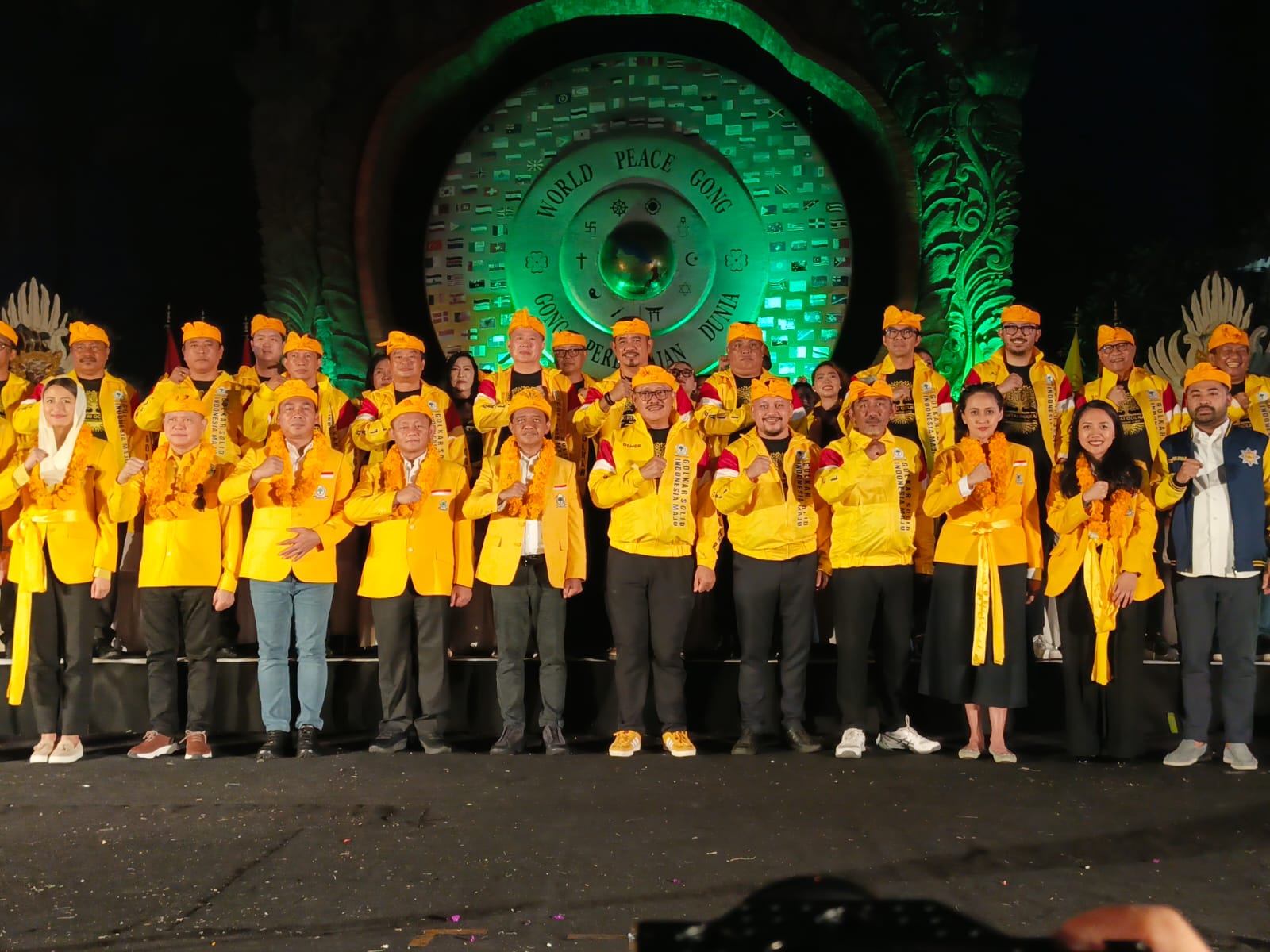
DENPASAR, BALINEWS — Golkar Party Chairman Bahlil Lahadalia and several members of President Prabowo Subianto’s cabinet attended the inauguration of Golkar executives at the provincial and regency/city levels across Bali at the World Peace Gong in Denpasar on Saturday (Oct. 3, 2026).
Bahlil, who also serves as Coordinating Minister for Downstreaming and Energy Transition, attended the event alongside Golkar Secretary-General and Industry Minister Muhammad Sarmuji, Minister for the Protection of Indonesian Migrant Workers Mukhtarudin, Minister of Micro, Small and Medium Enterprises Maman Abdurrahman, Deputy Trade Minister Dyah Roro Esti Widya Putri, Deputy Minister for the Protection of Indonesian Migrant Workers Christina Aryani, and House of Representatives member Puteri Komarudin.
The delegation arrived at around 5:30 p.m. local time and was greeted by Golkar cadres and supporters, many of whom were dressed in the party’s signature yellow.
During the ceremony, I Gede Sumarjaya Linggih, popularly known as Demer, was formally inaugurated as chairman of the Bali Golkar Party provincial executive board. Chairpersons and executive members of Golkar’s regency and city branches across Bali were also inaugurated.
The inauguration followed a regional working meeting, or Rakerda, held by the Bali Golkar leadership earlier on Saturday. The meeting discussed the party’s work programs as well as its strategy for navigating political developments and preparing for the 2029 general election.
In his address, Bahlil called on the newly inaugurated executives to make Golkar an instrument of public service and strengthen the party’s organizational network down to the grassroots level.
He also stressed the importance of maintaining cadre cohesion and strengthening the party’s organizational structure ahead of the 2029 election.
Bahlil has previously set a target for Golkar to increase its representation in the House of Representatives, where the party currently holds 102 seats.
Bahlil said party decisions should serve as the main reference for all levels of the organization. He also reaffirmed Golkar’s commitment to supporting the administration of President Prabowo Subianto and Vice President Gibran Rakabuming Raka.
According to Bahlil, party consolidation should not stop at the provincial or regency and city levels but should extend to communities at the village level.
In Bali, Bahlil also urged Golkar cadres not to regard other political parties as enemies. He emphasized the importance of maintaining relations and cooperation with other parties as part of Indonesia’s political process.
Meanwhile, Demer outlined the Bali Golkar Party’s preparations for the 2029 election during the regional working meeting.
He said political competition could become more challenging, particularly if the parliamentary threshold is increased to 5 percent.
Demer identified four areas that Golkar needs to strengthen: human resources, networks, management, and logistics.
“There are four things that, in my view, are necessary for success. The first, of course, is people,” Demer said.
He said cadres appointed to party structures should not merely fill organizational positions. Instead, they should have the ability to build public recognition and electoral support and contribute to the party’s vote share.
The second area is the party’s grassroots network. Demer said Golkar already has networks extending to regency and city as well as village levels, but these networks need to be strengthened further down to the hamlet level.
“There will be specific strategies for approaching the community, how to accommodate people’s aspirations, and how to build public support,” he said.
The third area is management, including the use of digital systems. Demer said party programs would be planned through the regional working meeting, organized systematically and implemented through direct engagement with communities.
Monitoring and evaluation, he added, would be strengthened through digital systems.
“Today, through the regional working meeting, we plan. Then we organize it properly. The action is to go out into the community. The controlling will later be done through our digital system,” Demer said.
The fourth area is logistics. Demer urged the party’s leadership at all levels to begin preparing the resources needed for the 2029 election.
He also called on Golkar cadres not to shy away from competition for legislative seats, citing past experiences in which concerns about competing against candidates with strong voter bases had resulted in Golkar losing seats in some areas.
“Do not be afraid to compete with those who have votes. We have experienced situations in several places where being afraid to compete resulted in losing seats,” he said.
Demer also reiterated Golkar’s proposal to change the mechanism for electing regional heads from direct elections to elections through regional legislative councils, or DPRDs.
He said the proposal had been put forward by Golkar at its National Leadership Meeting, or Rapimnas.
“Golkar proposed from the beginning, at the National Leadership Meeting, that regional elections be conducted through the DPRD. There are many considerations behind it,” Demer said.
Demer acknowledged that electing regional heads through DPRDs was not a popular option. However, he said Golkar considered the mechanism to be a better option for the public.
“Although this is not popular, according to Golkar, it is what is best for the people. That is why we are voicing it,” he said.
Demer also addressed the selection of the new party leadership structure. He said not all proposed names could be included in the new executive board, with candidates’ track records among the considerations in the selection process.
“If someone has a problematic record from the past, of course we leave them out,” Demer said.
He urged cadres who were not included in the new structure not to be discouraged, saying that opportunities within the organization could change over time.
“Everyone has their time, and every era has its people,” he said.
The inauguration of Golkar executives across Bali marked another step in the party’s organizational consolidation as it prepares its provincial and grassroots structures for the 2029 general election.