DENPASAR, BALINEWS — Bali’s proposed 2027 regional budget is projected to run a deficit of approximately Rp400 billion, as the provincial government prepares a spending plan that prioritizes public services and regional development while seeking to maintain fiscal stability.
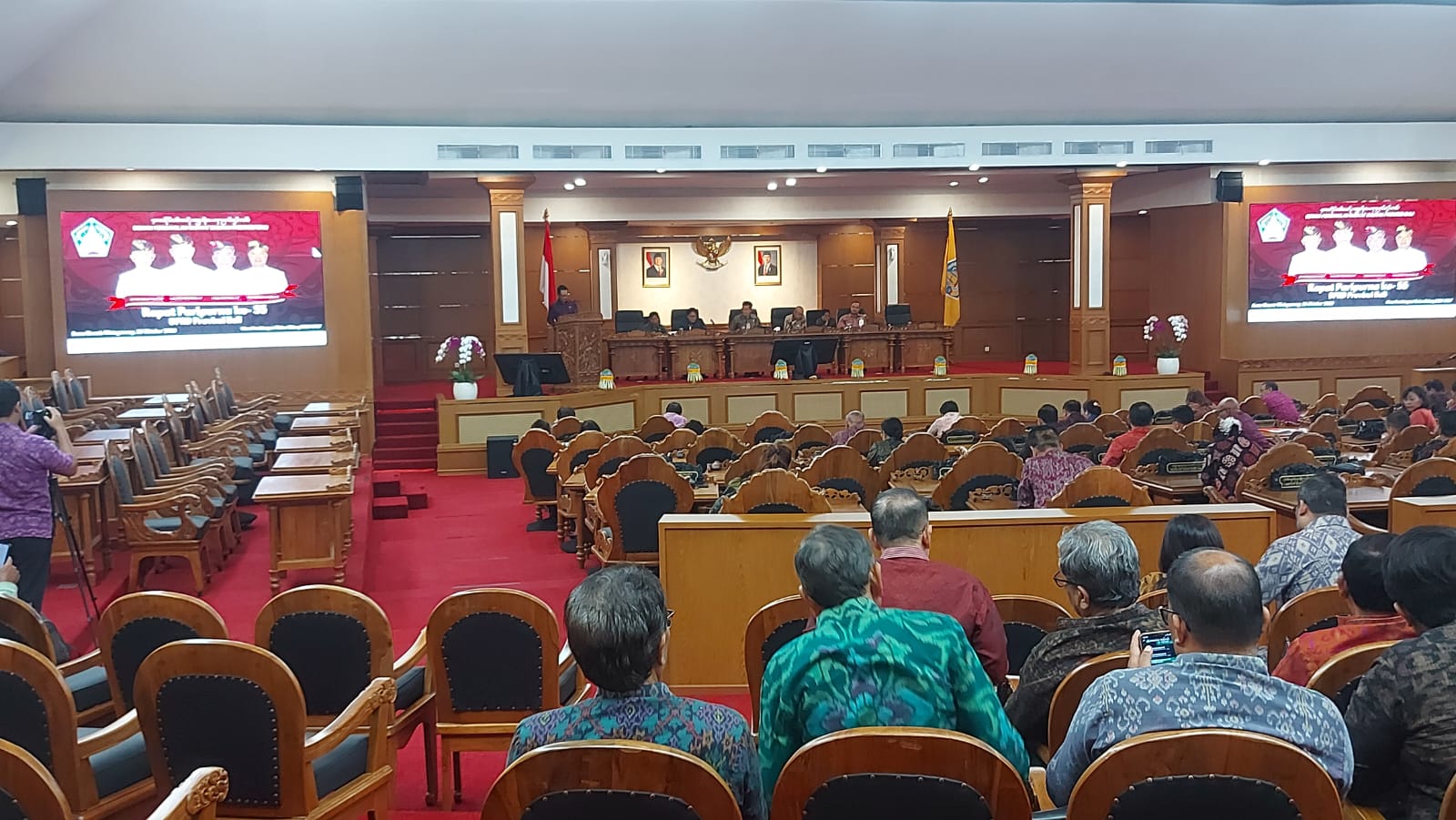
Bali Deputy Governor I Nyoman Giri Prasta delivered the estimate in response to general statements from factions of the Bali Regional House of Representatives (DPRD) on the draft 2027 Regional Revenue and Expenditure Budget (RAPBD) during the 55th Plenary Session of the First Session Period of the 2026–2027 legislative year on Monday (October 26, 2026).
Giri Prasta said the views and recommendations submitted by DPRD factions would serve as important considerations for the executive branch in refining the proposed budget. He stressed that the input must be carefully examined to ensure that budgetary policies serve the interests of the Balinese people.
He explained that the draft budget had been prepared in accordance with the applicable guidelines for the 2027 fiscal year. Based on the provincial government’s calculations, revenue is projected to exceed Rp5.2 trillion, while expenditure is estimated at approximately Rp6 trillion.
“Our calculations put the deficit at around Rp400 billion,” Giri Prasta said.
He expressed hope that the deficit could be reduced during budget implementation to preserve the province’s fiscal health. If additional funding is still required, the government will consider addressing the shortfall through the 2027 Revised Regional Budget, in accordance with applicable regulations.
Following the presentation of the factions’ general views, the provincial government will conduct a detailed analysis with the Regional Government Budget Team (TAPD). The findings will then be discussed with the DPRD factions before the budget proceeds to the next stages of deliberation and verification by the Ministry of Home Affairs.
In its general statement, the Indonesian Democratic Party of Struggle (PDI-P) faction of the Bali DPRD raised concerns about several aspects of the proposed 2027 budget, including locally generated revenue, expenditure priorities, deficit financing and the effectiveness of public spending in improving residents’ welfare.
The faction noted that Bali’s locally generated revenue, known as Pendapatan Asli Daerah (PAD), is projected to exceed Rp4.5 trillion in 2027. Total regional expenditure is projected at more than Rp6.1 trillion, while capital expenditure is allocated approximately Rp337 billion.
The faction’s statement, read by Ni Kadek Darmini, called on the provincial government to explain the assumptions underpinning its revenue targets, including actual revenue collections, updated taxpayer records, taxpayer compliance levels and the estimated potential of each revenue source.
According to the faction, efforts to increase revenue should focus on improving administration, expanding digital systems, preventing revenue leakage and optimizing regional assets, rather than placing excessive additional tax and levy burdens on residents and businesses.
The PDI-P faction also urged the government to prepare for the possibility that revenue from tourism-related sectors could fall short of expectations. Bali’s dependence on tourism, it said, must be considered when assessing the province’s ability to finance public services and meet its spending commitments.
Capital expenditure was another area of concern. The faction called for careful evaluation of whether the available fiscal space would be sufficient to support infrastructure development, healthcare and education services, agriculture, micro, small and medium-sized enterprises (MSMEs), public transportation, and waste management and pollution control.
The faction emphasized that limited fiscal resources must be matched by transparent and measurable spending plans to ensure that public funds deliver tangible benefits to the community.
Responding to concerns over a reduction in the nominal education budget, Giri Prasta said the provincial government would continue to comply with statutory requirements for education spending.
He stated that education would receive 21 percent of the province’s 2027 initial budget, above the minimum allocation of 20 percent stipulated under Indonesia’s Law No. 20 of 2003 on the National Education System.
According to Giri Prasta, budget efficiency measures would be implemented while ensuring that Bali’s education needs could still be met, despite budget adjustments and a reduction in revenue-sharing transfers from the central government.
The PDI-P faction, meanwhile, stressed that fiscal constraints should not undermine the quality of public services or the effectiveness of development programs. It urged the government to ensure that economic growth translates into more employment opportunities, higher productivity among local communities, stronger non-tourism sectors and more equitable prosperity.
Under the proposed 2027 budget, the provincial government has set an economic growth target of 5.60–6.40 percent. The targets also include a poverty rate of 2.75–3.40 percent and an open unemployment rate of 1.75–2.25 percent.
The PDI-P faction expressed support for accelerating Bali’s economic transformation, while emphasizing that development outcomes must be assessed through concrete and measurable improvements in people’s lives.
It called for stronger support for agriculture and MSMEs, broader access to employment, reduced regional disparities, and better protection of local residents’ access to adequate housing and living space. The faction also urged the government to ensure that investment complies with spatial planning regulations, respects environmental carrying capacity and contributes to local employment and public welfare.
The proposed 2027 budget will undergo further analysis by the provincial government and TAPD, followed by discussions with DPRD factions and subsequent review in accordance with the regional budget approval process.