DENPASAR, BALINEWS – The Golkar Party faction in the Bali Provincial Regional House of Representatives (DPRD) has raised concerns over the low allocation for capital expenditure in Bali’s proposed 2027 regional budget, warning that limited development spending could hamper infrastructure improvements and widen economic disparities across the island.
The faction noted that capital expenditure in the 2027 Draft Regional Budget (RAPBD) is projected at approximately Rp337 billion, accounting for just 5.5 percent of total regional expenditure. It called on the provincial government to strengthen development funding to ensure that economic growth benefits communities more evenly across Bali.
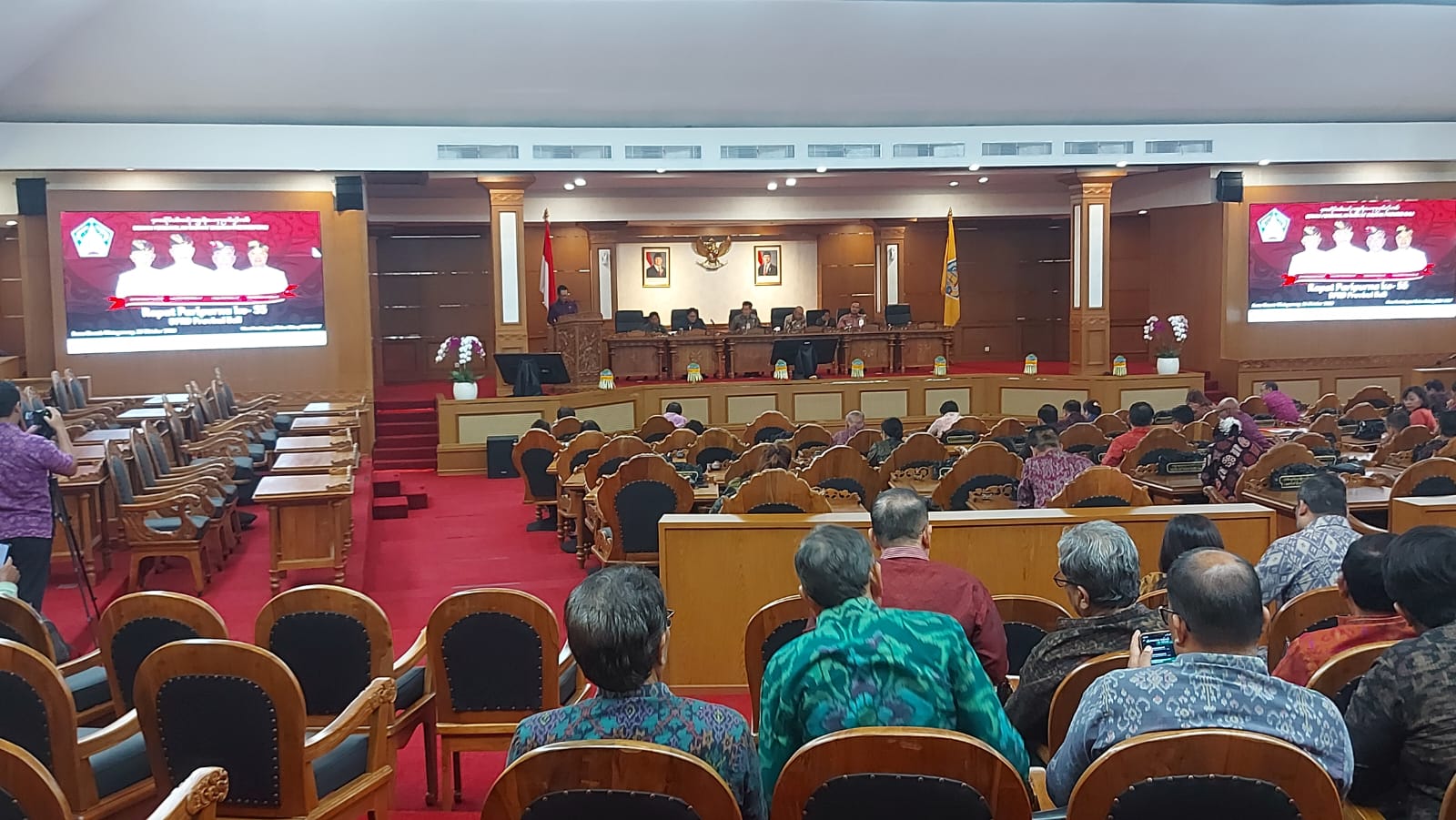
The position was presented by Drs. I Wayan Gunawan, M.AP., during the 55th Plenary Session of the Bali Provincial DPRD for the First Session of the 2026–2027 Legislative Year on Monday, October 26, 2026.
According to the faction’s general statement, Bali’s proposed 2027 budget projects regional revenue of more than Rp5.7 trillion and expenditure exceeding Rp6.1 trillion, resulting in a deficit of more than Rp475 billion, or approximately 8.32 percent.
Golkar argued that the budget should prioritize real economic growth, equitable income distribution and public welfare rather than being dominated by routine bureaucratic spending.
The faction proposed cutting operational expenditure unrelated to essential public services by 10–15 percent. The resulting savings, it said, should be redirected toward raising capital expenditure to at least 12 percent of total regional spending.
The additional funding would support integrated agricultural fertilizer subsidies, capital assistance for micro, small and medium-sized enterprises (MSMEs), and accelerated infrastructure development in northern and western Bali.
The faction also highlighted disparities in economic growth between different parts of Bali.
Citing data from Statistics Indonesia (BPS), Golkar noted that Bali’s economy grew by 5.82 percent in 2025. However, Badung Regency recorded growth of 6.26 percent and Denpasar City 6.11 percent, while Jembrana Regency grew by 5.26 percent and Karangasem Regency by 5.25 percent.
Golkar said the figures underscored the need for stronger policies to promote economic development in northern, western and eastern Bali, where economic activity remains less concentrated than in the island’s southern region.
To address the imbalance, the faction proposed reforming the revenue-sharing mechanism for hotel and restaurant taxes, accelerating interregional transport connectivity, developing agricultural and fisheries processing industries, and offering incentives to investors establishing green industries and sustainable tourism businesses outside southern Bali.
Golkar also warned that Bali’s regional revenue remains heavily dependent on tourism and motor vehicle taxes. With regional own-source revenue projected to exceed Rp4.5 trillion in 2027, the faction urged the provincial government to prepare fiscal contingency measures in case of a downturn in global tourism.
It recommended improving the collection of the foreign tourist levy through digital systems, increasing dividends from regionally owned enterprises, and optimizing government-owned assets to generate additional non-tax revenue.
In education and healthcare, the faction called for improvements in teacher qualifications, more equitable school facilities, stronger preventive healthcare services and greater accountability in the use of special financial assistance for traditional villages.
Golkar further emphasized that infrastructure spending should address everyday community needs beyond major strategic projects, including road repairs, improvements to subak irrigation networks and better waste management across regencies and cities.
The faction also addressed fuel shortages that had triggered long queues at several gas stations across Bali.
Golkar proposed establishing a provincial coordination body or dedicated unit to monitor fuel demand and distribution, identify potential supply disruptions early, and accelerate coordination among relevant agencies.
The proposed unit would serve as a coordination mechanism for the provincial government without taking over the statutory responsibilities of state-owned energy company Pertamina or the Downstream Oil and Gas Regulatory Agency (BPH Migas).
Other issues raised included traffic congestion in the Sarbagita metropolitan area, allegedly unlicensed tourist accommodation, misuse of immigration permits by foreign nationals, and concerns over street crime. The faction urged the provincial government to strengthen regulatory enforcement, integrate public transportation and improve coordinated security measures.
Separately, Golkar expressed support for the provincial government’s planned Rp150 billion capital injection into PT Bank BPD Bali.
However, the faction said the investment should translate into greater access to productive financing for MSMEs, agriculture and the creative economy. It also called for improved transparency and expanded digital banking services.
Following its assessment of the proposed budget, the Golkar faction stated that it accepted the 2027 Bali Regional Budget Draft to proceed to the next stage of deliberations in accordance with the applicable legislative procedures.
The faction emphasized that the provincial government should ensure that every rupiah of public spending delivers tangible benefits, strengthens essential public services and reduces development disparities across Bali.