DENPASAR, BALINEWS — The Gerindra-PSI faction of the Bali Regional House of Representatives (DPRD) has raised concerns over a 12.78 percent decline in projected regional revenue in Bali’s proposed 2027 budget, urging the provincial government to provide a detailed explanation of its financing plans, including the availability of Rp1.229 trillion in funding expected to be covered by previous-year budget surpluses and other financing receipts.
Under the proposed 2027 Regional Budget (APBD), Bali’s revenue is projected to fall to Rp5.72 trillion from Rp6.56 trillion in 2026, a decrease of approximately Rp840 billion.
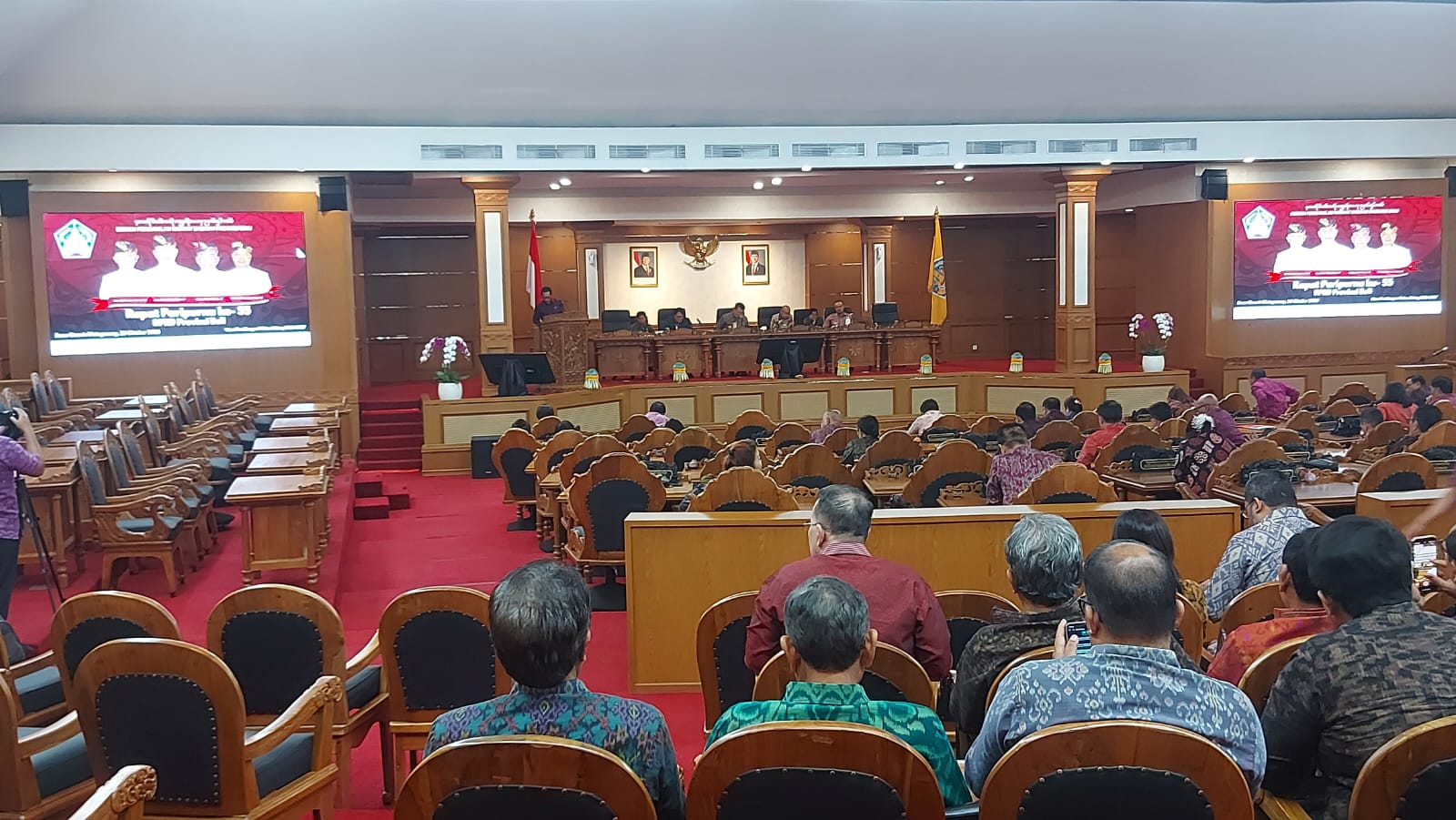
The concerns were presented during the 55th plenary session of the Bali DPRD on Monday (Oct. 26, 2026), when Gerindra-PSI legislator Gede Harja Astawa delivered the faction’s general remarks on the proposed budget.
The faction also noted that regional expenditure is projected to decline by 14.40 percent, from Rp7.24 trillion in 2026 to Rp6.19 trillion in 2027. Meanwhile, the budget deficit is expected to fall by approximately 30 percent, from Rp679.93 billion to Rp475.95 billion.
Gerindra-PSI said the projected reductions in revenue and expenditure required greater transparency, particularly regarding their potential impact on public services and priority development programs.
In addition to the projected deficit of Rp475.95 billion, the proposed budget includes financing expenditures of Rp753.46 billion. This brings the total financing requirement to approximately Rp1.229 trillion.
The faction called on the Bali governor to provide a detailed breakdown of the projected financing sources, particularly the availability of the Sisa Lebih Perhitungan Anggaran (SiLPA), or unspent budget balance from the previous fiscal year.
It also requested clarification on funds already earmarked for specific purposes, stressing that the use of budget surpluses must not compromise the delivery of public services.
Gerindra-PSI also questioned the decline in regional revenue, which it said was linked to a nearly 50 percent reduction in transfers from the central government.
The faction asked the provincial administration to explain the reasons behind the decline, provide projections for the coming years, and outline concrete measures to maintain regional fiscal stability.
It also sought clarification on the absence of projected interregional transfers in the proposed 2027 budget, urging the government to explore funding cooperation among regencies and municipalities for projects and services that cross administrative boundaries.
Foreign tourist levy revenue was another major concern.
Gerindra-PSI questioned the basis for a Rp600 billion revenue target from Bali’s foreign tourist levy in 2027, given that previous collections had fallen short of their targets.
The faction requested data on the number of foreign tourists required to pay the levy, the number who had paid, compliance rates, collection challenges, and concrete measures to improve revenue through better system integration and oversight.
Despite Bali’s relatively positive macroeconomic indicators, Gerindra-PSI warned that economic growth had not necessarily translated into evenly distributed prosperity.
The proposed 2027 budget assumes economic growth of 5.60 to 6.40 percent, an open unemployment rate of 1.75 to 2.25 percent, and a Human Development Index (HDI) of 79.10 to 80.00.
The faction argued that these indicators should be accompanied by policies addressing disparities in the distribution of economic benefits.
It stressed that the regional budget should be more than a financial balancing document. Instead, it should improve basic public services, strengthen economic resilience, protect the environment, and raise living standards across Bali.
In the infrastructure sector, Gerindra-PSI highlighted the proposed allocation of Rp79.62 billion for roads, networks, and irrigation in the 2027 budget.
The faction asked the provincial government to clarify whether the allocation adequately accounted for damaged provincial roads, irrigation maintenance requirements, and public safety risks.
It also called for detailed updates on the physical progress, financial realization, and public benefits of three strategic projects: the Besakih Sacred Area development, Turyapada Tower, and the Bali Cultural Center.
According to the faction, these projects must deliver tangible benefits, have clearly defined plans for future use, and avoid unnecessary spending or long-term operating costs that could place additional pressure on the regional budget.
Gerindra-PSI also requested a detailed breakdown of mandatory spending on education, healthcare, basic infrastructure, social protection, and other legally required expenditures. The breakdown should include allocation percentages, calculation methods, and comparisons with the previous fiscal year.
The faction also highlighted the gap between Bali’s 2026 provincial minimum wage of Rp3,207,459 per month and an estimated decent living requirement of Rp5.25 million per month.
The difference amounts to approximately Rp2.04 million per month.
Gerindra-PSI urged the provincial government to strengthen its assessment of decent living costs, optimize the role of the Wage Council, and pursue fairer wage policies in accordance with applicable regulations.
The faction stressed that economic growth, particularly in Bali’s tourism sector, should be accompanied by improvements in workers’ welfare.
Environmental management was another priority raised by the faction.
Gerindra-PSI requested clarification on budget allocations for waste management, including the planned Waste-to-Energy (WtE) facility, which is targeted to begin operating in 2028.
The faction also called for stronger measures to prevent the conversion of agricultural land, protect green areas, address water pollution, and safeguard coastal and marine ecosystems.
It further urged the provincial government to improve its preparedness for potential fuel shortages, following previous incidents in which long queues at fuel stations disrupted workers’ mobility and food logistics across Bali.
The faction proposed a transparent, real-time digital information system showing fuel availability at individual gas stations to help residents plan their journeys and reduce disruption.
Gerindra-PSI emphasized that its critical stance on the proposed 2027 budget did not constitute opposition to development. Rather, the faction said it aimed to ensure that public funds were managed transparently and accountably and delivered tangible benefits to the community.
The faction urged the Bali governor to provide responses supported by measurable data, implementation timelines, and concrete follow-up commitments that the DPRD could evaluate through its oversight function.
The faction’s general remarks will serve as input for further deliberations between the provincial legislature and the Bali administration on the proposed 2027 Regional Budget.
The proposed budget, Gerindra-PSI said, should ultimately be judged not by the amount of money spent or the scale of infrastructure projects, but by the extent to which its benefits are felt by the people of Bali.