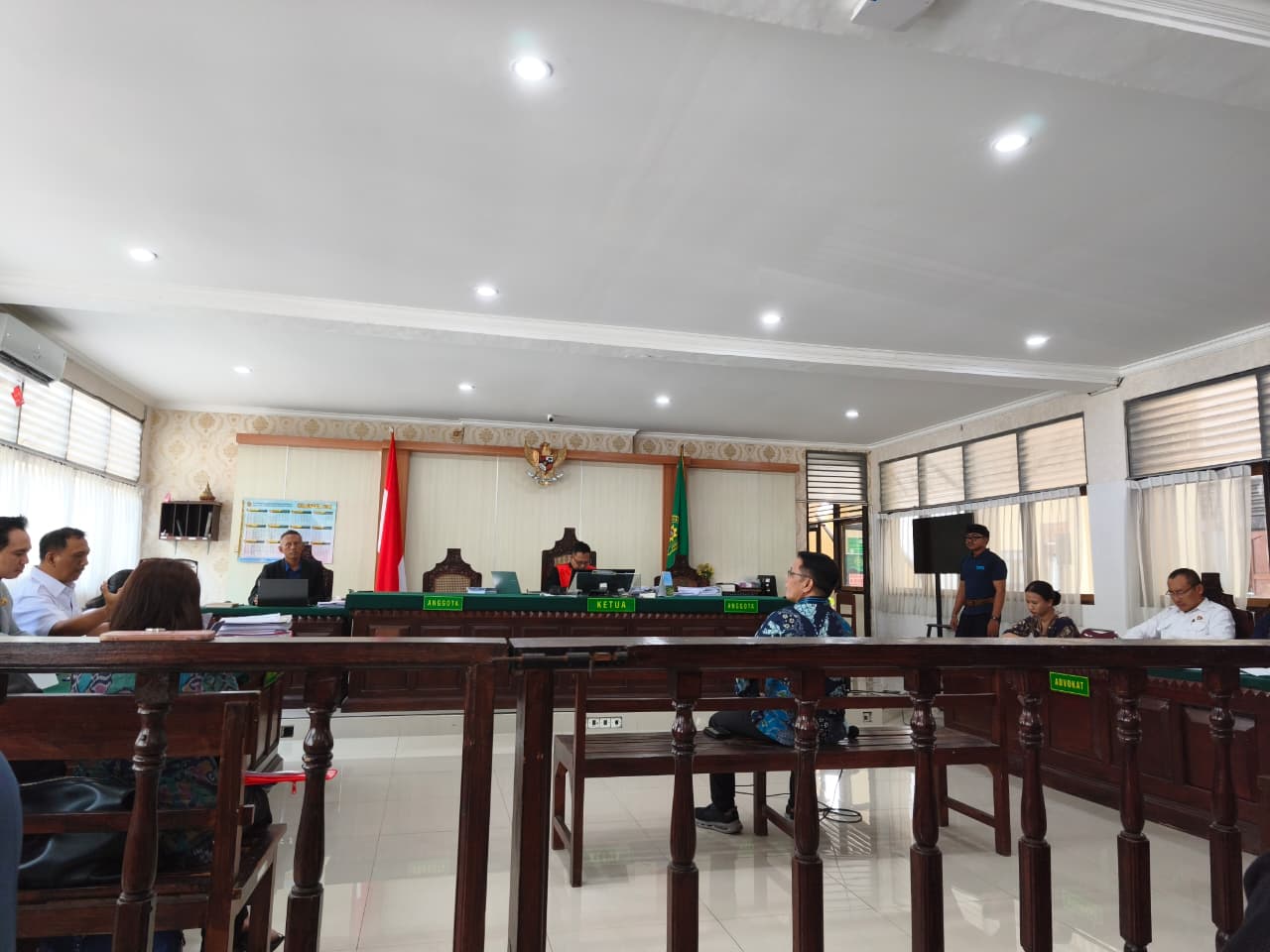
DENPASAR, BALINEWS — Criminal law expert Prof. Dr. Suparji has raised concerns over the procedures used to designate I Made Daging, former Head of the Bali Regional Office of the National Land Agency (BPN), as a suspect and to detain him. His remarks were delivered during a pretrial hearing at the Denpasar District Court on Friday, October 9, 2026.
Suparji argued that the judge must objectively examine the legal basis and evidence relied upon by investigators in designating Daging as a suspect and ordering his detention.
Suparji, a postgraduate lecturer at the Institute of Public Administration (IPDN) in Jakarta and a lecturer at Al-Azhar University Indonesia, said the allegation of document forgery must be assessed carefully against the material facts and evidence presented in the case.
“The document itself was valid. If the document was valid, then, in material terms, the allegation of creating a false document needs to be examined carefully,” Suparji said after the hearing.
He said pretrial proceedings provide a legal mechanism for reviewing investigators’ actions when questions arise over the procedures used to designate a suspect or impose detention. He urged the judge to assess the facts presented during the hearing and determine whether the investigators had acted in accordance with applicable law.
“I hope the pretrial judge can exercise oversight over investigators and order the legal proceedings to be set aside if the actions are found to be unlawful,” he said.
Suparji also questioned the grounds for Daging’s detention, stressing that the factual reasons and legal requirements for detention must be clearly established. If formal, procedural or substantive defects are found, he said, the judge may correct the investigators’ actions within the scope of the court’s authority.
He added that anyone who believes they have been harmed by investigators’ actions may pursue legal remedies or file a report if there are sufficient grounds to do so. According to Suparji, individuals should not be prevented from reporting suspected misconduct or a lack of due diligence by law enforcement officers.
Government Administration Expert Highlights Administrative Procedures
During the same hearing, government administration expert Dr. Frans Dione, S.IP., M.Si., explained the mechanisms for resolving administrative disputes under Law No. 30 of 2014 on Government Administration.
Frans emphasized that public officials do not enjoy absolute legal immunity. However, he argued that relevant administrative procedures should be considered before certain disputes involving government decisions or actions are brought into the criminal justice system.
He explained that administrative objections and administrative appeals are mechanisms available to challenge government decisions or actions. If the relevant administrative procedures have been followed, further legal action may still be taken, provided it complies with applicable laws and regulations.
His explanation highlighted the importance of distinguishing administrative disputes from alleged criminal offenses while ensuring that the appropriate legal procedures are followed.
Language Expert Explains Differences Between the Old and New Criminal Procedure Codes
Meanwhile, language expert Dr. Kadek Wirahyuni, S.Pd., M.Pd., from Ganesha University of Education (Undiksha), discussed linguistic differences between Indonesia’s former and new Criminal Procedure Codes, particularly provisions concerning detention.
Kadek explained that linguistic analysis is necessary to understand the meaning of words, affixes and sentence structures in legislation. In her view, the new Criminal Procedure Code contains more objective formulations because it establishes conditions that must be met before certain legal actions can be taken.
“Under the old Criminal Procedure Code, there was still room for assumptions or estimates. The new code is more objective because certain requirements must first be fulfilled,” Kadek said.
She added that individual words, including conditional terms such as “if,” can affect the interpretation of legal provisions by establishing relationships between specific circumstances and legal requirements.
For this reason, she said, linguistic analysis can help clarify the meaning of statutory provisions and reduce the risk of differing interpretations.
Kadek stressed that her testimony focused on the language used in legislation rather than directly assessing the merits of the case against Daging.
The experts’ statements formed part of the pretrial proceedings examining the procedures used to designate Daging as a suspect and detain him. The final determination of whether the investigators’ actions were lawful rests with the judge, based on the evidence presented and the applicable legal framework.