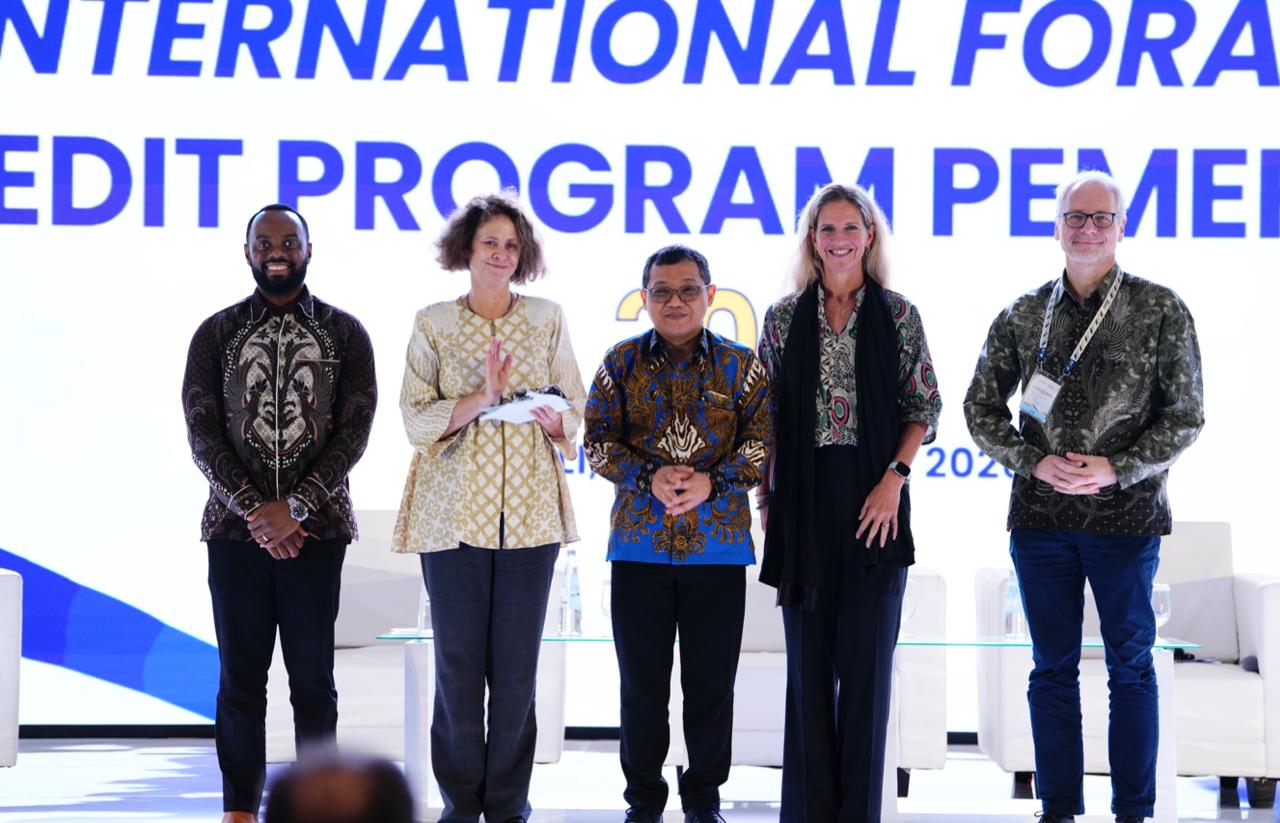
BADUNG, BALINEWS – Indonesia’s cumulative government-backed loan disbursement has reached IDR 2,440 trillion through 58.1 million loan agreements since 2015, as of October 27, 2026. The achievement was among the key experiences shared by Indonesia at an international forum on financing for micro, small, and medium enterprises (MSMEs) in Nusa Dua, Bali.
Indonesia’s experience in developing the People's Business Credit (Kredit Usaha Rakyat/KUR) program since 2007 was a major focus of an international seminar titled Global Trends in Inclusive Finance and MSME Development, held on Thursday (October 29, 2026).
The seminar, which opened the 2026 International Forum on Government Credit Programs, brought together the Indonesian Government, the World Bank, Women's World Banking, and KfW Development Bank to exchange insights on expanding inclusive, targeted, and impactful MSME financing.
Deputy for Coordination of State-Owned Enterprise Management and Development at the Coordinating Ministry for Economic Affairs, Ferry Irawan, emphasized the strategic role of MSMEs in driving Indonesia's national economy.
Indonesia currently has 56.7 million MSMEs, of which 96.7 percent are micro-enterprises with annual sales of up to IDR 2 billion.
To broaden access to financing, the government has integrated five credit instruments into a unified policy framework: People's Business Credit (KUR), Agricultural Machinery Credit (Kredit Alsintan), Labor-Intensive Industry Credit (KIPK), Housing Program Credit (KPP), and Credit for Women in Underprivileged Communities (KPPS), which is currently entering its launch phase.
"For us, MSME financing is not simply about increasing the volume of loans disbursed. What matters most is reaching the right borrowers, providing appropriate financing, and helping their businesses grow," Ferry said.
The government also highlighted the development of the KUR program, which is designed to expand access to financing while maintaining credit quality.
As of September 30, 2026, KUR had reached 1.87 million new borrowers. In addition, approximately 900,000 borrowers had successfully moved up to higher business classifications, reflecting improvements in their business capacity.
In terms of financing costs, the interest rate for super-micro KUR loans is set at 3 percent, while micro-KUR loans for productive sectors carry an interest rate of 6 percent.
The government has also eased financing requirements by allowing KUR loans of up to IDR 100 million without requiring additional collateral.
Meanwhile, the share of KUR financing allocated to productive sectors increased from 60.7 percent in 2025 to 66 percent in 2026.
Maintaining credit quality remains another priority. The non-performing loan (NPL) ratio for government credit programs stood at 2.13 percent as of September 30, 2026.
The implementation of KUR is supported by a clear division of responsibilities among relevant institutions, the Government Credit Program Information System (SIKP), and a graduation mechanism that enables borrowers to progress from super-micro KUR to micro-KUR, small-business KUR, and eventually commercial loans.
The impact of KUR financing can also be seen in the business development of Ratih Paramitasari, owner of Maha Gema Indonesia, based in Gunungkidul, Yogyakarta Special Region.
Ratih first accessed KUR financing in 2017. As her business expanded, she subsequently secured an additional loan of IDR 300 million at an interest rate of 6 percent to build a new warehouse.
Today, her business employs 28 local residents and markets billiard cue stick cases to both domestic and international markets, including the United States.
Her business journey illustrates how access to financing can help MSMEs increase production capacity, expand market reach, and create employment opportunities.
During the forum, international partners also shared research findings and experiences in developing inclusive financing systems across different countries.
A World Bank study covering more than 8 million KUR borrowers found that 61 percent had never received a loan before accessing the program.
The findings highlight KUR's role in expanding access to formal financing for business owners who had previously been underserved by the banking sector.
The World Bank also shared insights from a survey of 108 credit guarantee institutions across 74 countries.
Meanwhile, KfW Development Bank presented the experience of the European Fund for Southeast Europe (EFSE), which combines financing with technical assistance and training.
According to the EFSE 2025 Impact Report, the scheme has facilitated EUR 12.6 billion in sub-loans to MSMEs and households while supporting 2.9 million indirect jobs.
Looking ahead, the Indonesian Government aims to further strengthen MSME financing through better-integrated data systems and improved measurement of program outcomes.
As of the end of 2025, Indonesia's Single MSME Database had recorded 30.2 million MSMEs.
The government expects that the exchange of knowledge and experience at the international forum will contribute to the further development, implementation, and evaluation of government credit programs, enabling more entrepreneurs to gain access to financing and opportunities to grow their businesses.
The international seminar was part of the 2026 International Forum on Government Credit Programs and was supported by several strategic partners, including PT Bank Rakyat Indonesia (Persero) Tbk, PT Bank Mandiri (Persero) Tbk, PT Bank Negara Indonesia (Persero) Tbk, PT Bank Tabungan Negara (Persero) Tbk, PT Bank Syariah Indonesia Tbk, PT Bank Pembangunan Daerah Bali, PT Jaminan Kredit Indonesia, PT Asuransi Kredit Indonesia, PT Pegadaian, PT Permodalan Nasional Madani, BPJS Ketenagakerjaan, and PT Bank Central Asia.