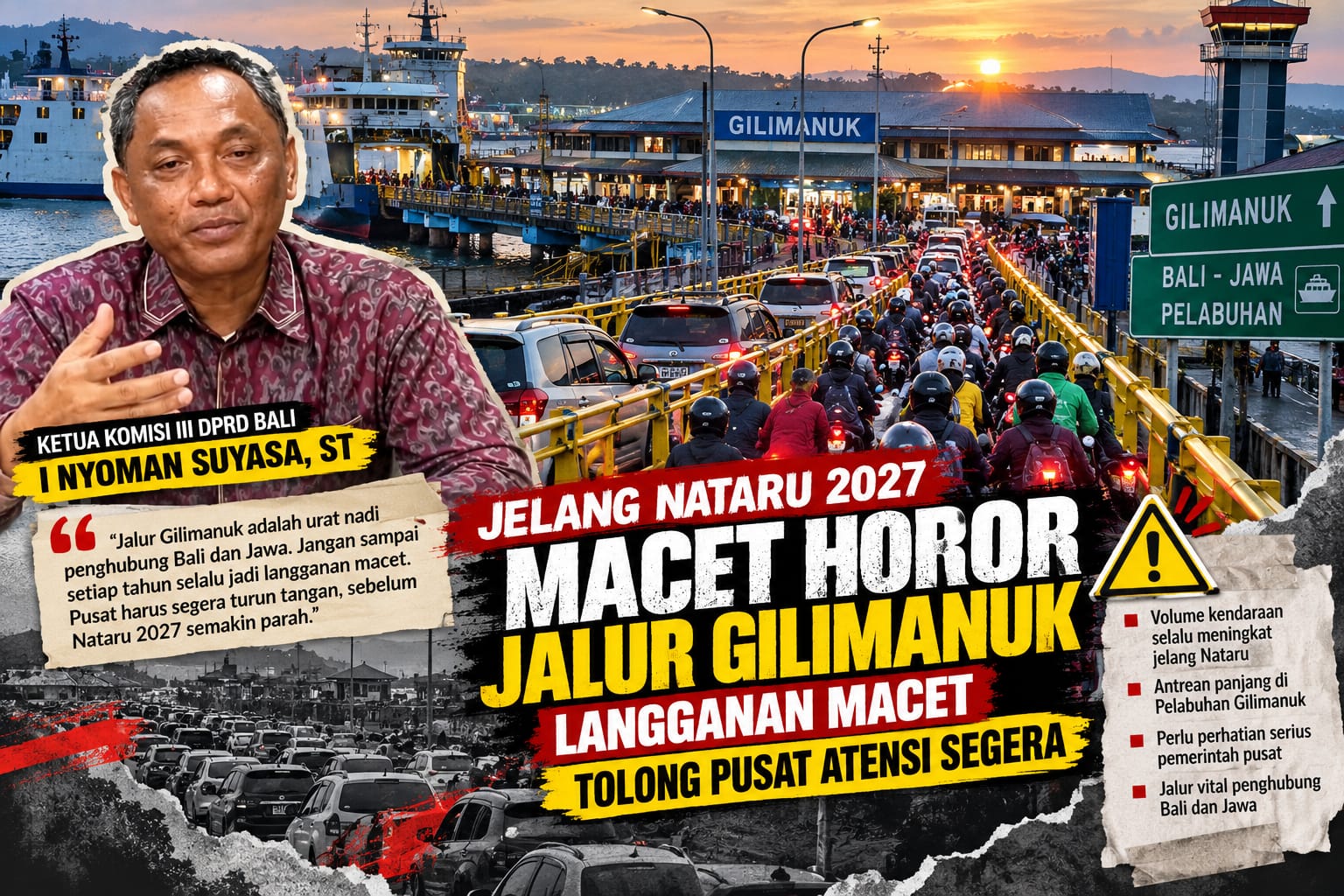
DENPASAR, BALINEWS – The Indonesian Online Journalists Association (Ikatan Wartawan Online/IWO) of Bali Province has raised concerns over the potential for severe traffic congestion during the 2027 Christmas and New Year (Nataru) holiday season. To prevent major traffic disruptions, IWO Bali is urging Commission III of the Bali Provincial Legislative Council (DPRD) to take strategic measures and call on the central government to give greater attention to road conditions and transportation access leading to Gilimanuk.
The issue emerged during IWO Bali's monthly #NgopiSantuy discussion, which featured Nyoman Suyasa, ST, Chairman of Commission III of the Bali Provincial DPRD, as the guest speaker. The discussion was held at a coffee shop in Denpasar on Friday, October 30, 2026, focusing on developments in Bali's tourism industry and infrastructure.
IWO Bali considers transportation infrastructure readiness a critical issue that must be addressed well in advance. Bali is expected to experience a significant increase in vehicle movements and tourist arrivals during the year-end holiday period, including traffic entering and leaving the island through Gilimanuk Port.
The Gilimanuk route serves as one of the main land transportation links connecting Bali with Java. Consequently, road conditions, traffic capacity, and the smooth movement of vehicles require serious attention to prevent lengthy queues that could disrupt community activities and the tourism sector.
During the discussion, Nyoman Suyasa acknowledged that Bali's tourism growth must be accompanied by adequate infrastructure development.
He noted that international tourist arrivals in Bali reached approximately 7.05 million in 2025. In 2026, the figure is projected to increase to between 7.1 million and 7.2 million visitors.
When combined with domestic tourists, total annual visits to Bali are estimated to reach approximately 16 million.
According to Suyasa, the increasing volume of tourist arrivals and mobility cannot be addressed solely through road construction or road widening. Spatial planning, regional development management, and the protection of water sources must also be incorporated into Bali's broader development strategy.
"When discussing the development of Bali's tourism industry in relation to infrastructure, we cannot focus solely on road construction or increasing road capacity. There are more important aspects to consider, including spatial planning, regional management, and the protection and management of water resources," Suyasa explained.
Apart from the Gilimanuk route, traffic congestion in southern Bali was another major concern raised during the discussion.
The growing number of tourists and increasing community activities are considered disproportionate to the capacity of the existing road infrastructure, placing additional pressure on the region's transportation network.
Several potential solutions were discussed, including the development of mass public transportation, proposed tram routes, road widening, and the restructuring of logistics vehicle routes.
In preparation for the 2027 Christmas and New Year holiday season, stronger coordination among relevant government agencies, including the Bali Transportation Agency, was also considered essential.
Traffic management measures and the possible rerouting of logistics vehicles were among the options discussed to reduce pressure on heavily congested tourism areas.
IWO Bali Provincial Chairwoman Tri Widiyanti said that #NgopiSantuy is a monthly discussion program designed to create an open communication platform between journalists, government representatives, and other stakeholders.
Through this forum, IWO Bali seeks to encourage critical discussions on current public issues, particularly development policies and infrastructure projects that directly affect people's daily lives.
IWO Bali hopes that Commission III of the Bali Provincial DPRD will follow up on these infrastructure concerns through stronger coordination and communication with the central government, particularly regarding improvements to the Gilimanuk transportation corridor.
Preventive measures are considered necessary to ensure that transportation access does not once again become a major source of severe congestion during the peak of the 2027 Christmas and New Year holiday season.
The discussion was attended by the Chairpersons and representatives of IWO Denpasar City and IWO Badung Regency, along with administrators and members of IWO Bali Province.
Through #NgopiSantuy, IWO Bali reaffirmed its commitment to strengthening the role of the press as a channel for public aspirations and an institution of public policy oversight, particularly on issues concerning infrastructure readiness and the interests of the Balinese community.
By bringing journalists and policymakers together in an open discussion, IWO Bali hopes to encourage greater attention to transportation challenges and promote concrete measures to improve infrastructure preparedness ahead of the 2027 holiday season.