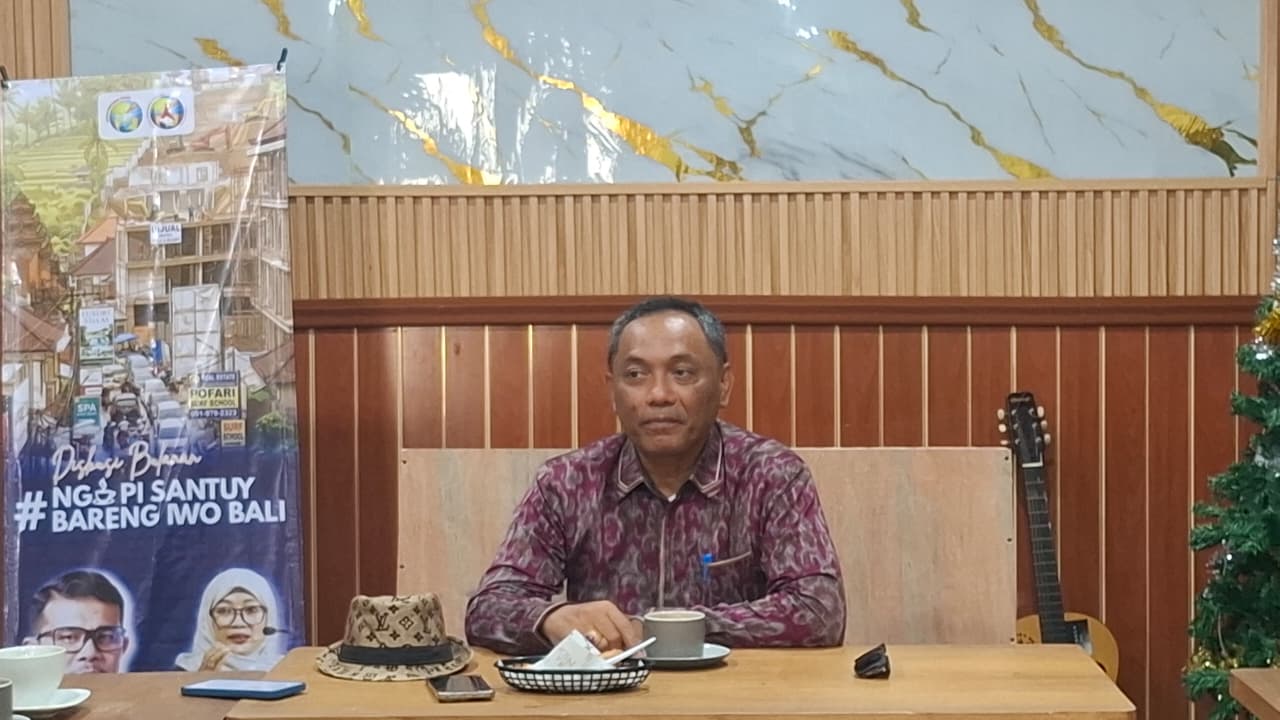
DENPASAR, BALINEWS – Bali’s growing waste problem took center stage during the monthly #NgopiSantuy discussion organized by the Bali Provincial chapter of the Online Journalists Association (IWO) on Friday (October 30, 2026).
The discussion featured Nyoman Suyasa, Chairman of Commission III of the Bali Provincial Legislative Council (DPRD Bali), who addressed a range of issues concerning regional development, infrastructure, and strategies to tackle the island’s mounting waste challenges.
Held at a modest coffee shop in Denpasar, the event was chaired by IWO Bali Chairperson Tri Widiyanti. Although conducted in an informal setting, the discussion provided journalists with an opportunity to raise critical questions about current issues affecting the community.
During his presentation, Suyasa emphasized that waste management in Bali is a complex challenge that cannot be resolved through a single approach. He stressed the need for thorough and comprehensive planning, along with close cooperation among regional governments, legislative and executive institutions, and the public.
He also highlighted the importance of the legislative council's oversight role in monitoring government policies and the implementation of public programs, particularly those related to waste management.
According to Suyasa, the DPRD has three primary functions: legislation, budgeting, and supervision. Meanwhile, the implementation of government programs and the management of allocated budgets fall under the responsibility of the executive branch.
"I would not say that it has failed. Our responsibilities in the DPRD are legislation, budgeting, and oversight. The implementation of the budget is the responsibility of the executive branch. Therefore, we must maintain mutual oversight," Suyasa said during the discussion.
Suyasa noted that addressing Bali’s waste problem requires multiple solutions to be implemented simultaneously rather than relying on a single strategy.
One of the key initiatives under consideration is a waste-to-energy project that aims to convert waste into electricity. The pilot project has attracted attention from the central government and is expected to become part of Bali’s long-term waste management strategy.
He expressed hope that the project would provide a sustainable solution to the island’s growing waste challenges. According to Suyasa, the government is targeting 2027 as the year the waste-to-energy program begins operations.
Nevertheless, he cautioned that short-term waste management measures must not be neglected while the project is being prepared.
Local governments, he said, need to implement concrete and immediate measures to prevent the waste problem from placing an even greater burden on communities and the environment.
Beyond waste management, the discussion also addressed several development and infrastructure issues across Bali.
Participants raised concerns about the maintenance of public buildings, road infrastructure, and irrigation facilities, all of which were considered to require greater attention.
Limited maintenance budgets were also highlighted as one of the challenges affecting the proper upkeep of public infrastructure.
The discussion provided an opportunity for journalists to communicate public concerns directly to policymakers and seek clarification on issues that require government attention.
IWO Bali Chairperson Tri Widiyanti explained that #NgopiSantuy is planned as a regular monthly program featuring influential figures and key stakeholders from across Bali.
In addition to discussing public policies and current issues, the forum also allows journalists to gain a closer understanding of their guests, including their professional activities, perspectives, and everyday experiences, through open and informal conversations.
The event was attended by the Chairperson and representatives of the IWO Denpasar City chapter, the Chairperson and representatives of the IWO Badung Regency chapter, as well as board members and other members of IWO Bali.
Through the initiative, IWO Bali hopes that pressing public issues, particularly waste management, will receive greater attention from the government and become part of a broader process of public evaluation and collaboration.
Ultimately, the forum aims to encourage stronger collective efforts toward creating a cleaner, more comfortable, and more sustainable Bali.