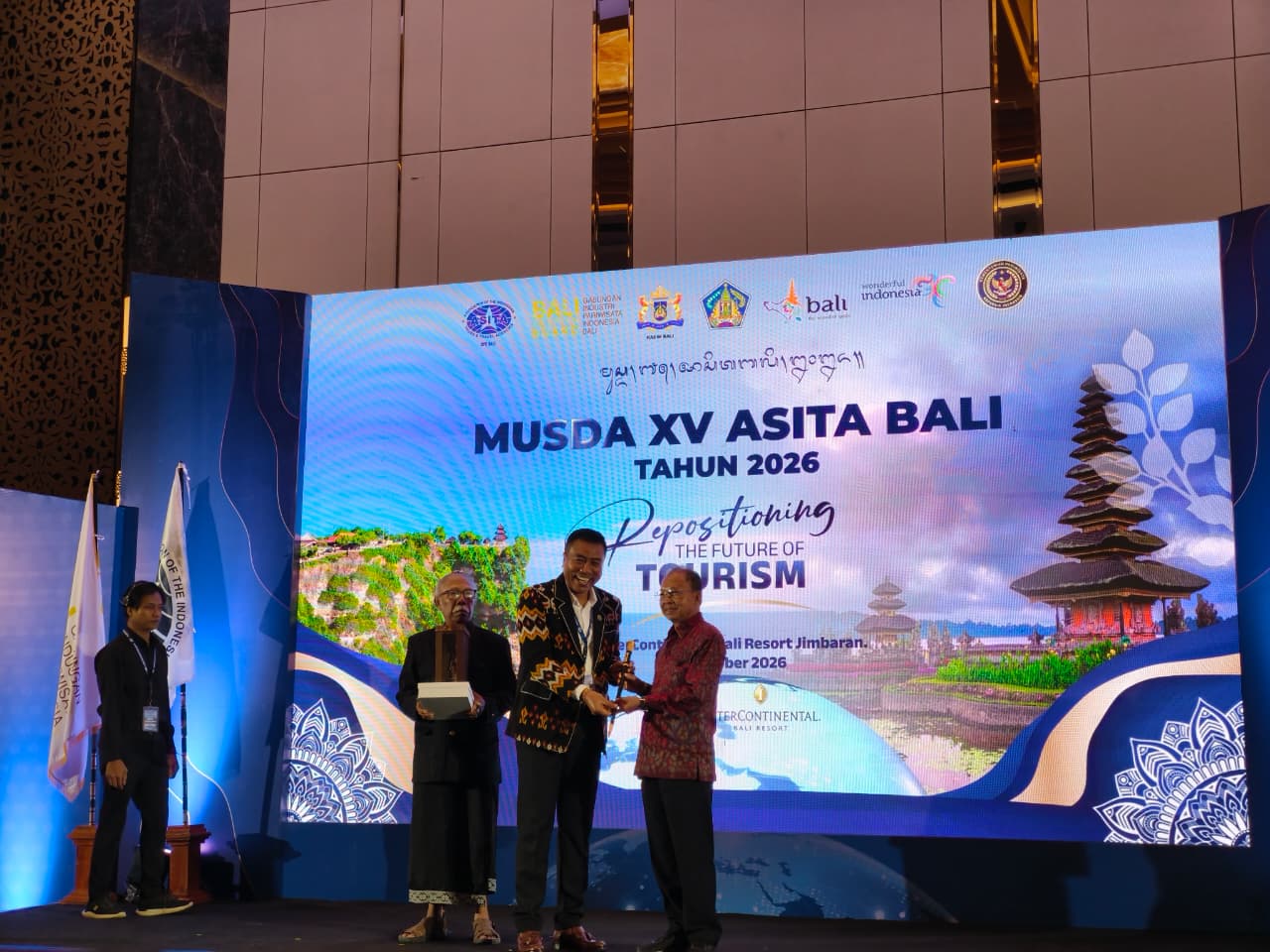
JIMBARAN, BALINEWS — I Putu Winastra, S.AB., M.A.P., has once again been entrusted with leading the Bali Regional Board of the Association of the Indonesian Tours and Travel Agencies (ASITA Bali), pledging to steer the organization toward regenerative tourism that delivers tangible benefits to local communities, preserves cultural heritage, and protects the environment.
Winastra outlined this vision during the 15th ASITA Bali Regional Conference (MUSDA XV ASITA Bali 2026), held at the InterContinental Bali Resort in Jimbaran on Friday, October 16, 2026. Under the theme “Repositioning the Future of Tourism,” the conference served as a platform to strengthen the role of travel agencies in advancing responsible and sustainable tourism across Bali.
Winastra emphasized that ASITA must go beyond its traditional role of bringing tourists to destinations. Through its extensive network of travel agencies, the organization is strategically positioned to guide visitors toward experiences that support local economies, respect Balinese culture, and contribute to environmental conservation.
“ASITA can be more than just a distributor of tourists. It can also guide travel toward a more responsible, meaningful, and beneficial form of tourism for destinations,” Winastra said in his address.
He explained that regenerative tourism goes beyond minimizing the negative impacts of tourism. It seeks to generate positive contributions to the environment, cultural preservation, and community well-being.
To achieve this, travel agencies can encourage visitors to explore tourism villages, purchase locally made products, appreciate local traditions, and adopt environmentally responsible practices. Encouraging longer stays in Bali can also help distribute tourism revenue more widely among local communities.
Winastra stressed that addressing Bali’s tourism challenges requires collaboration among the government, tourism businesses, local communities, academics, media organizations, and other stakeholders.
“Bali’s tourism challenges cannot be solved by any single party. All stakeholders must move in the same direction,” he said.
During his address, Winastra highlighted several initiatives undertaken by ASITA Bali to strengthen tourism promotion and industry networks, including the Bali and Beyond Travel Fair (BBTF), BALI Tourism Run, and SAKIRA.
He noted that BBTF brings together tourism industry players and buyers from 44 countries, involving more than 1,000 participants. ASITA Bali has also established collaborations with several tourism destinations, including Monkey Forest Ubud, Jatiluwih, and Besakih Temple.
Winastra further stated that approximately 63 percent of offline tourist visits to Bali were supported by the networks and activities of ASITA Bali members. He said the figure demonstrated the significant role travel agencies play in attracting visitors, as well as their responsibility to help maintain the quality and sustainability of tourism destinations.
In addition, ASITA Bali has introduced the ASITA Care program to strengthen the organization's commitment to local communities, environmental protection, and the broader tourism ecosystem.
Looking ahead, Winastra said ASITA must adapt to technological developments, changing travel patterns, shifting market dynamics, and growing demand among tourists for high-quality experiences and sustainable destinations.
He expressed his commitment to continuing existing programs, addressing areas that require improvement, strengthening unity among members, and increasing ASITA Bali's contribution to the island's tourism industry.
“Positions have a time limit, but dedication has no limits,” he said.
Through MUSDA XV ASITA Bali 2026, the organization is expected to reinforce its strategic direction and partnerships with the Bali provincial government, regency and municipal administrations, relevant ministries, tourism associations, and other stakeholders.
The broader objective is to ensure that Bali's tourism growth is measured not only by visitor numbers but also by its contribution to local prosperity, environmental sustainability, and the preservation of the island's cultural values.
ASITA Bali aims to play a greater role in shaping a tourism industry that delivers meaningful experiences for visitors while safeguarding Bali's natural and cultural heritage for future generations.