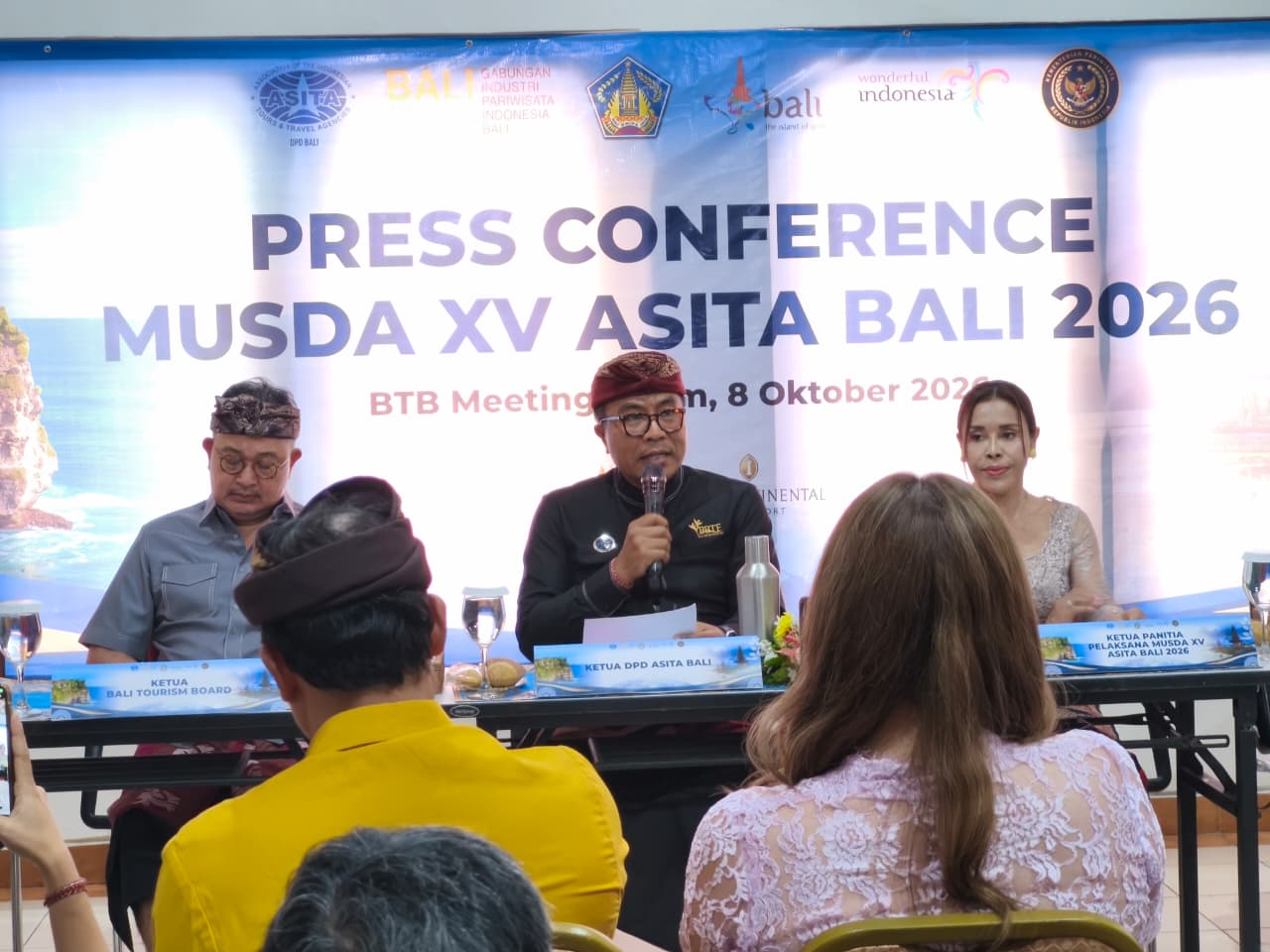
DENPASAR, BALINEWS — The Bali chapter of the Indonesian Travel Agents Association (ASITA) will hold its 15th regional conference, or MUSDA XV ASITA Bali 2026, on Oct. 16, 2026, at the InterContinental Bali Resort in Jimbaran.
Held under the theme “Repositioning the Future of Tourism,” the conference will address several strategic issues facing Bali’s tourism industry, including the redistribution of tourism activity, enforcement of tourism business regulations and the strengthening of local businesses.
Organizing committee chair IG Ayu Kade Purnamawati said the event is expected to attract 250 travel agencies from ASITA Bali’s 371 members.
“As of today, 223 active ASITA Bali members have registered, including both full members and associate members,” she said at a press conference at the Bali Tourism Board (BTB) office in Renon, Denpasar, on Thursday (Oct. 8, 2026).
The conference is also expected to be attended by the chairman of the ASITA national board, the Bali governor, the Bali Tourism Office, regents and mayors across Bali, the Bali Tourism Board, tourism stakeholders and industry partners.
Winastra Runs Unopposed
I Ketut Ardana, chairman of the MUSDA XV steering committee, said the process of selecting candidates for ASITA Bali chairman had been conducted in accordance with the organization’s rules.
The candidate nomination process was announced to all ASITA Bali members on Sept. 24, 2026. Eligible members were given until 6 p.m. on Oct. 2 to declare their willingness to run and submit their candidacy.
“By the deadline, the Steering Committee had received and recorded one candidate, namely I Putu Winastra, S.AB., M.A.P., who previously served as chairman of ASITA Bali,” Ardana said.
ASITA Calls for Tourism Beyond Southern Bali
Winastra said the theme “Repositioning the Future of Tourism” has two main directions: institutional repositioning and destination repositioning.
On the institutional side, ASITA aims to strengthen its role as an organization representing legal and professional travel businesses.
According to Winastra, ASITA should not only advocate for the interests of its members but also contribute to and provide solutions for Bali’s tourism policies.
“ASITA must become more solid as an organization representing legal and professional travel businesses,” he said.
On the destination side, ASITA Bali is calling for tourism activity to be expanded beyond the island’s southern region, where much of Bali’s tourism activity is concentrated.
Winastra said North, East and West Bali have significant tourism potential that needs to be developed through proper planning.
Developing destinations outside southern Bali, he said, would give tourists more choices while creating opportunities for tourism-related economic benefits to be distributed more evenly.
“This is not simply about moving tourists. It is an effort to reduce pressure on one area while creating economic opportunities in other areas,” he said.
The development of new destinations could also create opportunities for local communities, micro, small and medium-sized enterprises, transportation providers, accommodation businesses, restaurants, tour guides and the creative economy, he said.
Tourism redistribution, therefore, is not merely a destination-development strategy but also an effort to expand economic opportunities for Balinese communities.
ASITA Calls for Consistent Enforcement
ASITA Bali is also calling for stricter enforcement against tourism businesses operating without proper legal status or outside existing regulations.
Winastra said the issue should not simply be viewed as competition between online and offline businesses. What matters, he said, is the consistent application of regulations to all tourism businesses.
“Legal businesses must receive certainty. Those that have not met the requirements should be guided to comply or sanctioned in accordance with the regulations,” he said.
He warned that inconsistent enforcement could create unfair competition.
Some businesses, he said, have fulfilled obligations such as paying taxes, obtaining permits and employing local workers, while others allegedly continue operating without meeting all regulatory requirements.
ASITA Bali is therefore urging the government to conduct supervision and enforce regulations consistently, fairly and without discrimination.
Local Businesses Should Not Become Spectators
ASITA Bali also emphasized the need to strengthen the position of local businesses amid continued investment in Bali’s tourism sector.
Winastra stressed that ASITA was not opposed to investment. Bali, he said, still needs investment to support tourism development.
However, investment should comply with regulations and generate tangible benefits for the local economy.
“We encourage healthy partnerships between investors and local businesses, including legal and professional travel agencies,” he said.
He warned that tourism investment should not end up limiting opportunities for local businesses to grow.
“Balinese people must be part of tourism growth, not merely spectators,” Winastra said.
In this context, ASITA’s membership in the Bali Chamber of Commerce and Industry (KADIN) for the 2025-2030 period is considered important to ensure that the concerns of travel businesses are represented in discussions on Bali’s economic and tourism policies.
ASITA also aims to serve as a bridge between the government, businesses, communities and other tourism stakeholders.
Beyond Visitor Numbers
Winastra said Bali’s tourism future should not be measured solely by the number of visitors arriving on the island.
More important, he said, is whether tourism can deliver quality, sustainable and increasingly equitable benefits to Balinese communities.
Through MUSDA XV, ASITA Bali wants to encourage tourism stakeholders to take a broader view of the island’s tourism future.
“It is not only about how Bali receives tourists, but how Bali manages the future of its tourism industry,” he said.
Winastra said he hoped Bali would maintain its position as a global tourism destination while developing a tourism industry that is better managed, higher quality, sustainable and provides greater opportunities for local communities.
“Bali must continue to grow. But that growth must be directed so that its benefits can be enjoyed together,” he said.