JAKARTA, BALINEWS — Indonesia’s Constitutional Court (Mahkamah Konstitusi or MK) has ordered lawmakers to amend Law No. 31 of 1997 on Military Courts within a maximum of two years, addressing the jurisdiction of courts over Indonesian National Armed Forces (TNI) personnel accused of ordinary criminal offenses.
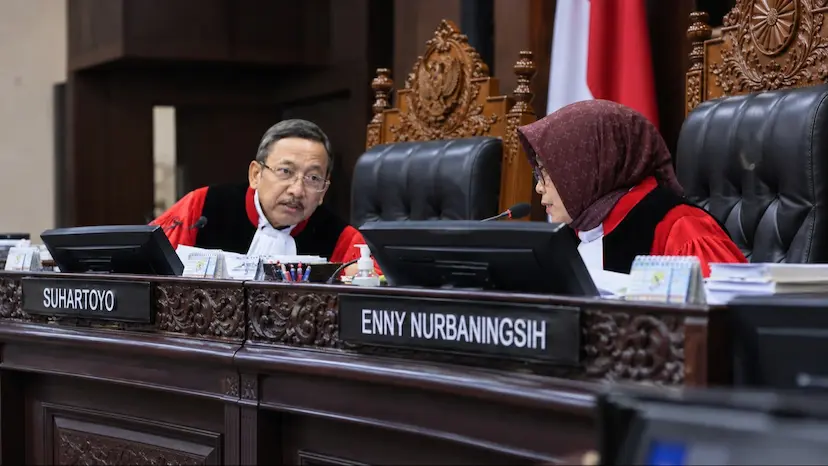
The ruling, Case No. 260/PUU-XXIII/2025, was delivered by Chief Justice Suhartoyo during a hearing at the Constitutional Court building in Jakarta on Thursday, October 15, 2026. The court granted the petitions in full, which were filed by Lenny Damanik and Eva Meliani Br. Pasaribu.
In its legal reasoning, the court emphasized that the jurisdiction of a court should be determined by the nature of the alleged offense, rather than solely by the accused person’s status as a member of the military.
Under this principle, ordinary criminal offenses committed by TNI personnel should fall under the jurisdiction of civilian courts, while offenses specifically related to military law should remain within the military justice system.
The court also ruled that Law No. 31 of 1997 is conditionally unconstitutional and will have no binding legal force if it is not amended within a maximum of two years from the date of the ruling.
The responsibility for revising the legislation rests with the House of Representatives (DPR) and the government. The amendment is intended to establish clearer boundaries between military and civilian courts in handling criminal cases involving military personnel.
Deputy TNI Commander Says Ruling Will Be Reviewed
Responding to the court’s decision, TNI Deputy Commander General Maruli Simanjuntak said the military would study and discuss the ruling before determining its next steps.
His response comes as the decision raises questions about the future structure of the military justice system and the division of authority between military and civilian courts.
Further action by the government and the DPR will be necessary to ensure that the revised legislation complies with the court’s ruling.
The constitutional challenge was brought by Lenny Damanik, the mother of a junior high school student identified by the initials MHS, who died after being assaulted by a TNI soldier, and Eva Meliani Br. Pasaribu, the daughter of journalist Rico Sempurna Pasaribu, who died in a house-burning incident in Karo Regency, North Sumatra.
Both petitioners challenged provisions of the Military Courts Law that they argued created problems in determining which courts should handle ordinary criminal offenses allegedly committed by military personnel.
Following the ruling, the petitioners’ lawyer, Irvan Saputra, welcomed the decision as an important step toward reforming the military justice system.
Eva Meliani also expressed hope that the ruling would open the way for the case related to her father’s death to be handled through the civilian justice system.
Social Media Users Express Support
The Constitutional Court’s decision has attracted attention on social media, where several users have voiced support for equal treatment under the law, including for members of the security forces.
One user, operating under the account @indonesiajaya1819, called for harsher penalties for law enforcement and state personnel who commit crimes, writing: “AND THE SENTENCE SHOULD BE DOUBLED BECAUSE THEY ARE STATE OFFICIALS, IN ADDITION TO DISHONORABLE DISMISSAL.”
Another user, @merahmuda-v3s, questioned why the reform had not been introduced earlier. The comment reportedly received 295 replies.
Support also came from @AhmadIrfan-s3i, who wrote: “Good, this is progress in the law, so officials won’t act arrogantly and can set a good example.”
These comments reflect the views of some social media users responding to the ruling. However, they should not be taken as representative of public opinion as a whole.
The ruling places the revision of Law No. 31 of 1997 on the legislative agenda of the DPR and the government. Clearer rules governing judicial jurisdiction are expected to help ensure that criminal cases are handled according to the nature of the offense and the principle of equality before the law.
The implementation of the ruling will depend on the legislative process and the specific provisions set out in the court’s decision. The two-year deadline gives lawmakers and the government a defined period to revise the legal framework governing military justice.
The next stage will be to translate the court’s decision into clear and enforceable legislation, establishing how ordinary criminal offenses committed by military personnel should be handled within Indonesia’s judicial system.