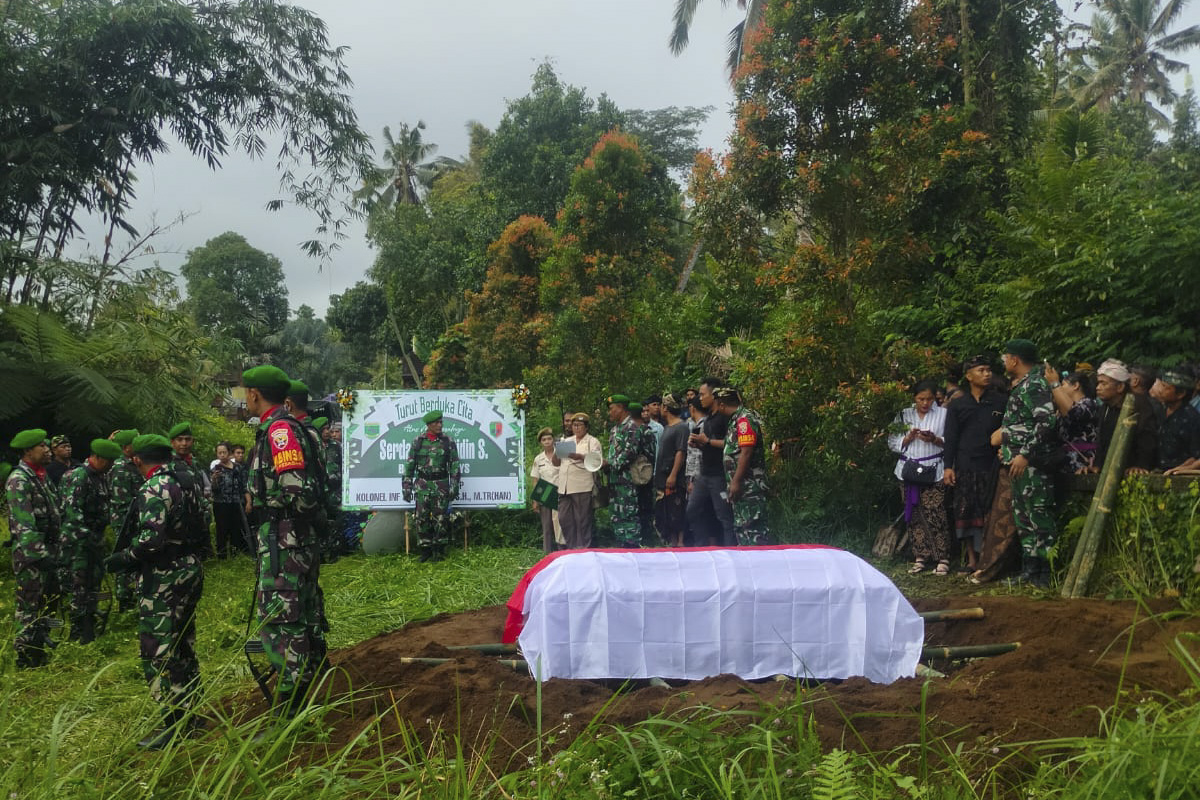
DENPASAR, BALINEWS – Two years after the death of Indonesian Army soldier Serda I Gede Didin Saputra, his family is still waiting for full information about the legal proceedings surrounding his death, according to the Indonesian Legal Aid Foundation (YLBHI)-LBH Bali.
LBH Bali, which is assisting Didin’s family, said the family has yet to receive a complete copy of the ruling issued by the Military Court III-19 in Jayapura, Papua, which handled the case.
The legal aid organization said the lack of access to the ruling was not merely an administrative matter but could constitute a violation of the family’s human rights, particularly their right to information and access to justice.
The case began with an alleged act of violence within the military environment while Didin was serving with Infantry Battalion 762/Vira Yudha Sakti in Papua.
Three Indonesian military personnel were subsequently named suspects in connection with the case: Filipus Ola Aman Bala, I Kadek Putra Adiana and Faizal Prayitno.
Their cases were heard by Military Court III-19 Jayapura under case registration numbers 407-K/PM.III-19/AD/XI/2024, 408-K/PM.III-19/AD/XI/2024 and 409-K/PM.III-19/AD/XI/2024.
Two of the defendants, Filipus Ola Aman Bala and I Kadek Putra Adiana, were subsequently convicted by the military court.
LBH Bali has previously criticized the proceedings, saying the military trial was conducted behind closed doors and that the victim’s family was not adequately involved. The organization has also described the sentences handed down as too lenient and insufficient to meet the family's sense of justice.
According to LBH Bali, the family formally requested copies of the court rulings through its legal representatives.
On July 7, 2026, YLBHI-LBH Bali sent Letter No. 084/SK/YLBHI-LBH BALI/VII/2026 to the chairman of Military Court III-19 Jayapura, through the court’s registry, requesting copies of the rulings in all three cases.
On the same day, the organization also sent a request to the Chief Justice of the Supreme Court of Indonesia through the Supreme Court Registry under Letter No. 085/SK/YLBHI-LBH BALI/VII/2026.
However, LBH Bali said the family had still not received the requested complete rulings or an adequate response to their requests.
The organization argued that the right to obtain information is guaranteed under Article 28F of Indonesia’s 1945 Constitution and Article 14 of Law No. 39 of 1999 on Human Rights.
LBH Bali said access to information should not be treated merely as a facility provided at the discretion of the state, but as a fundamental right that authorities are obligated to respect, protect and fulfill.
For the family, the organization said, access to the ruling is particularly important because it would allow them to understand the facts considered by the court, the evidence examined, the legal reasoning applied and the basis for the court’s conclusions.
LBH Bali Questions Military Court Transparency
LBH Bali also reiterated its concerns over what it described as the lack of transparency in the military justice process in Didin’s case.
The organization said the closed nature of the proceedings and the family's limited participation had created greater distance between the judicial process and those directly affected by Didin’s death.
LBH Bali argued that military courts, despite their specialized jurisdiction, remain part of Indonesia’s judicial system and therefore should uphold the principles of transparency, accountability and respect for human rights.
The organization warned that restricting the family's access to the ruling could prevent them from understanding how the state had held those responsible for Didin’s death accountable.
“Military courts must not become exclusive spaces that protect institutional interests at the expense of victims’ rights,” LBH Bali said in its statement.
LBH Bali also criticized Law No. 31 of 1997 on Military Courts, which remains the legal foundation for Indonesia’s military justice system.
The organization specifically highlighted Article 196, arguing that it does not clearly establish the right of victims or their families to obtain copies of court rulings.
Under the provision, copies of rulings are provided to certain officials and to defendants or their legal counsel upon request. Copies may also be provided to “other persons” with the permission of the head of the court after considering the purpose of the request.
LBH Bali questioned whether a victim’s family should effectively be treated as an “other person” who must first obtain permission to access a ruling concerning the death of their family member.
The organization said the law does not clearly define who qualifies as an “other person,” what constitutes a legitimate interest, or what criteria court officials should use when approving or rejecting such requests.
LBH Bali argued that these provisions should be interpreted alongside constitutional guarantees of access to information and justice, as well as the principles of judicial transparency and accountability.
YLBHI-LBH Bali called on the Supreme Court and Military Court III-19 Jayapura to immediately provide the victim’s family with complete copies of the rulings through a lawful, transparent and accessible mechanism.
The organization also urged the National Human Rights Commission (Komnas HAM) to monitor and investigate the alleged violations of the family’s rights to information and justice.
In addition, LBH Bali called on the Supreme Court and the government to reform the administration of military justice to ensure greater transparency, accountability, victim participation and public access to information.
The organization further urged the Indonesian government and House of Representatives (DPR RI) to promptly revise Law No. 31 of 1997, including by establishing clearer provisions concerning the rights of victims and their families throughout military judicial proceedings.
LBH Bali said reform of the military justice system could no longer be delayed and that military courts must remain subject to the rule of law, equality before the law, transparency, accountability and effective protection and remedy for victims.