
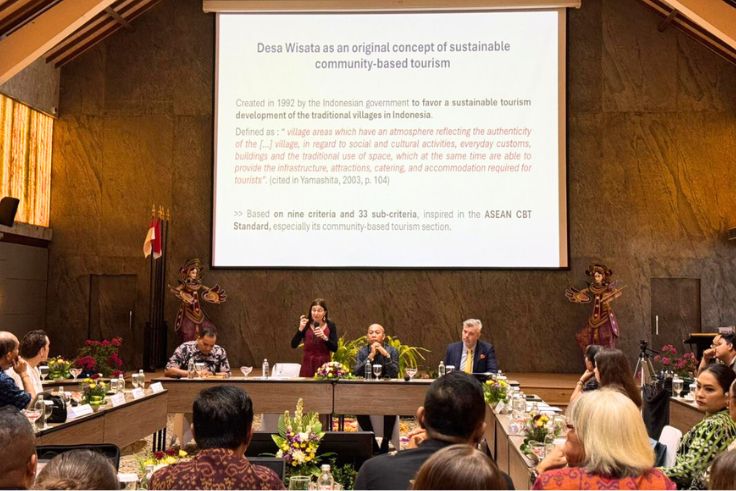
BADUNG, BALINEWS.ID – The Doctoral (PhD) Program in Tourism Business at Politeknik Negeri Bali (PNB) held the Sustainable Tourism Business International Symposium (STBis) PNB 2026 under the theme “Embedding Inclusivity and Sustainability for the Resilience of Future Tourism” at Grand Istana Rama, Kuta, on Friday (March 13, 2026).
The academic event brought together scholars and tourism practitioners from five countries, Indonesia, France, Germany, Italy, and the Netherlands, to discuss strategies for developing a more sustainable tourism industry.
Chair of the organizing committee, Prof. Ni Made Ernawati, MATM., Ph.D., explained that participants included representatives from professional associations, industry stakeholders, and doctoral students.
“Participants include representatives from several associations that we invited, as well as industry professionals and our doctoral students. This event essentially supports the seminar learning process in our PhD program. Currently, our doctoral students consist of two cohorts, most of whom are industry practitioners such as general managers and heads of departments,” she said.
According to Prof. Ernawati, the symposium serves as an important academic platform for doctoral students and researchers to present their studies while strengthening their understanding of strategic issues in tourism business.
“As academics at the doctoral level, we need a scientific forum to present research findings and deepen academic understanding. That is why we organized a symposium specifically focusing on tourism business and how the sector can develop sustainably,” she added.
She emphasized that sustainability has become a global agenda that must be addressed by all stakeholders in the tourism sector. Through this forum, various research papers are presented to provide recommendations that can help the tourism industry grow in a sustainable manner.
Ernawati also highlighted that sustainability encompasses not only economic aspects but also social, cultural, and environmental dimensions. In her presentation, she discussed the importance of incorporating Balinese local wisdom as a value that can be applied in business practices to support sustainable development and corporate performance.
However, she acknowledged that Bali still faces several challenges in achieving sustainable tourism, including environmental issues such as flooding and waste management.
“Everyone must contribute, starting from the smallest scope, whether communities, educational institutions, or industry players. Hotels, for example, generate a significant amount of waste, so efforts such as recycling and waste reduction are essential,” she explained. She also highlight the importance of maintaining the quality of Bali’s tourism sector, including balancing the number of visitors with the economic value generated.
Meanwhile, Ketut Darmayasa, General Manager of Grand Istana Rama Hotel, expressed appreciation to Politeknik Negeri Bali for selecting the hotel as the venue for the academic symposium.
“This is the first symposium held since the doctoral program in Tourism Business was established at Politeknik Negeri Bali. The participants include doctoral students from the first and second cohorts, academics from several universities, representatives from professional associations, and tourism practitioners,” Darmayasa said.
He noted that the forum also addressed several major challenges facing Bali in maintaining tourism sustainability. Although international tourist arrivals to Bali reached around 7.1 million visitors in 2025, accounting for nearly 50 percent of Indonesia’s total foreign tourist arrivals, the island continues to face significant challenges.
Among the key issues discussed were waste management, water availability, the potential energy crisis triggered by global geopolitical tensions, and increasing traffic congestion.
In addition, global developments have begun to affect Bali’s tourism sector. Darmayasa mentioned that several flights from Europe and the Middle East have been canceled due to geopolitical tensions that have disrupted airport operations in those regions.
“The impact is starting to be felt, particularly in tourist arrivals from Europe and the Middle East. Hopefully the situation will improve soon, because the biggest concern is the potential for an energy shortage,” he said.
Through this symposium, academics, industry players, and stakeholders are expected to exchange ideas and produce concrete recommendations to strengthen the development of sustainable tourism in Bali in the future. (*)