JAKARTA, BALINEWS — Indonesia’s Coordinating Ministry for Community Empowerment (Kemenko PM) is encouraging a transformation of the country’s philanthropic sector, urging organizations to move beyond short-term assistance and focus more on strengthening people’s capacity and economic independence.
Suwatin, Assistant Deputy for Social Empowerment at Kemenko PM, said Indonesia’s philanthropic funds have significant potential to support poverty reduction, but their impact needs to be expanded through programs that deliver sustainable benefits to communities.
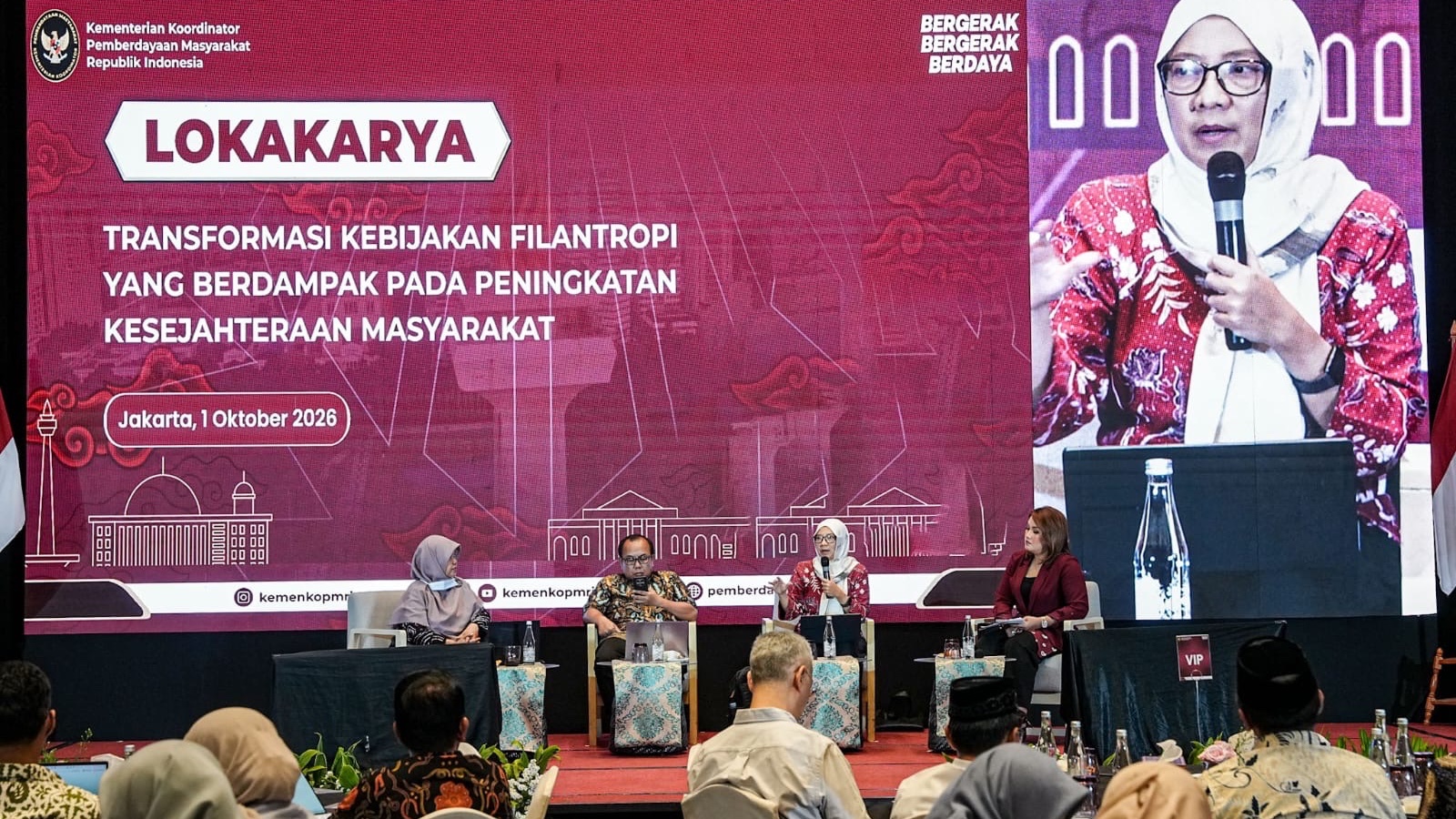
“Philanthropy is one of the great strengths of Indonesian society. What we need to encourage is not only how philanthropic funds are distributed, but how those funds can genuinely improve people’s welfare and help communities become more empowered,” Suwatin said at a workshop on transforming philanthropic policies to improve public welfare in Jakarta on Thursday (Oct. 1, 2026).
The initiative is in line with Presidential Instruction No. 8 of 2025 on optimizing poverty alleviation and the eradication of extreme poverty, which emphasizes collaboration among stakeholders and a community empowerment approach.
According to Statistics Indonesia (BPS), the national poverty rate fell to 8.07% in March 2026, equivalent to approximately 22.93 million people. The extreme poverty rate stood at 0.61%.
The figures are considered important progress, but further efforts are needed to meet the government’s target of eliminating extreme poverty in 2026 and reducing the national poverty rate to 5% by 2029.
Kemenko PM said broader participation from society, including the philanthropic sector, would be important in supporting those efforts.
The potential of philanthropy can also be seen in the country’s zakat sector. Indonesia’s Ministry of Religious Affairs recorded Rp44.7 trillion ($2.7 billion) in zakat, infaq, alms and other religious social funds collected in 2025. Around 81% of funds distributed through institutional channels were allocated to poor and vulnerable people.
However, the rapid growth of digital fundraising has also highlighted regulatory challenges.
The collection of money or goods is still governed by Law No. 9 of 1961 and Government Regulation No. 29 of 1980, regulations introduced decades before the widespread use of online banking, digital wallets and internet-based crowdfunding platforms.
The Ministry of Social Affairs recorded 108 ministerial-level permits for the collection of money or goods issued to 47 organizations in 2025, with reported funds totaling Rp562.4 billion.
More than 95% of those funds were reportedly collected through digital platforms, while existing regulations do not specifically address online fundraising.
Suwatin said regulatory reform was therefore needed to keep pace with technological developments while providing legal certainty and protecting both donors and beneficiaries.
“We need to ensure that regulations can keep up with the times, provide legal certainty for organizations seeking to comply, and at the same time protect people who donate and those who benefit from the funds,” she said.
She said regulatory reform should strike a balance between simplifying licensing procedures and protecting the public. Transparency, accountability and proportionate, risk-based oversight should also be strengthened.
Beyond regulation, Kemenko PM is encouraging philanthropy to become a strategic partner of the government in community empowerment.
Philanthropic funds, Suwatin said, should not only be used to meet immediate needs but also support skills development, access to economic opportunities and efforts to help communities achieve greater independence.
“Philanthropy should not stop at providing assistance. We want continuity between protection, recovery and empowerment, so that public generosity can become part of the pathway toward self-reliance,” Suwatin said.
The workshop was organized not merely as a public information forum but also as a platform for gathering input from philanthropic organizations about their experiences and challenges.
Kemenko PM brought together relevant ministries and government agencies with 21 philanthropic and community organizations to discuss simplifying licensing procedures, ensuring targeted distribution of funds, promoting empowerment-oriented programs and developing proportionate oversight mechanisms.
The outcomes of the workshop will be used as policy recommendations and input for the ongoing process of updating regulations governing the collection of money and goods. Kemenko PM also said immediate measures that can be jointly implemented with relevant ministries and agencies would be identified.
“Generosity is a form of social capital that has long been rooted in Indonesian society. Our task is not to place additional burdens on those who want to do good, but to ensure that every donation is managed responsibly and creates a real impact on people’s welfare,” Suwatin said.