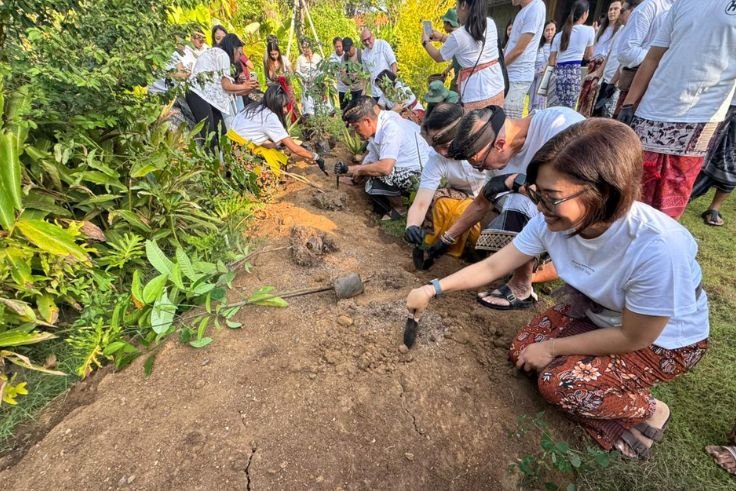
BALINEWS.ID – In celebration of Earth Day, The Meru Sanur and Bali Beach Hotel, The Heritage Collection, marked the occasion with a meaningful environmental initiative featuring tree planting inspired by the Balinese philosophy of Panca Maha Bhuta, alongside the announcement of its verified carbon emission reduction certification.
The ceremony was held at the Ethnobotanical Garden within “The Sanur” Special Economic Zone (KEK) for Health, highlighting the property’s ongoing commitment to sustainability, cultural heritage, and environmental preservation.
The tree-planting initiative draws inspiration from Panca Maha Bhuta, which represents the five fundamental elements of nature, mainly earth, water, fire, air, and ether. Each element is symbolically represented through selected indigenous plant species, forming a living ecosystem designed to reflect balance between humans and nature.
This initiative was conducted in collaboration with The Heritage Associates, long-serving individuals who have contributed since the era of Grand Inna Bali Beach. They were invited to witness the development of the Ethnobotanical Garden and participate in the symbolic planting, bridging legacy and future sustainability.
Beyond environmental symbolism, the initiative also integrates traditional Balinese healing wisdom known as Taru Pramana, emphasizing the role of plants in holistic wellbeing.
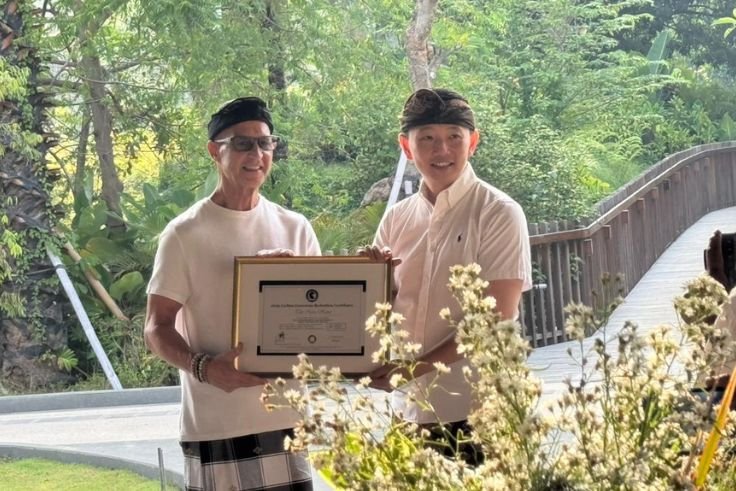
As part of the Earth Day commemoration, The Meru Sanur also announced its Carbon Emission Reduction Certificate for 2025, issued by GUAVA International, recognizing a measurable reduction of 20kg CO2e through the optimization of eco-friendly dry amenities used in guest rooms.
The certification was independently verified by KPMG, ensuring transparency, accuracy, and compliance with international sustainability standards.
This achievement reinforces the hotel’s commitment to integrating sustainability into daily operations.
General Manager of The Meru Sanur and Bali Beach Hotel, The Heritage Collection, Ed Brea, highlighted the broader significance of Earth Day and the long-term vision behind the initiative.
“Earth Day has been celebrated since 1970, and today it has become a global movement observed in over 190 countries. What we are doing here in the Ethnobotanical Garden is part of a much larger journey,” said Brea.
“We have planted right now, about 150 indigenous species here in the echo botanical garden. So it’s a wonderful display of, you know, what Bali has to offer, as far as all of the floral and fauna,” he added.
Global Sustainability Collaboration
Representing GUAVA International, Gabriel explained that the collaboration with The Meru Sanur is part of a broader global sustainability framework supported by the United Nations, focusing on scalable environmental solutions in the hospitality industry.
He noted that the organization, recognized by the UN for its work in circular economy and sustainable tourism initiatives, aims to make sustainability both measurable and accessible for global implementation.
“We hope to create solutions that are not only sustainable but also scalable. Consumers today demand accountability, and sustainability must be backed by measurable data,” Gabriel said.
He also emphasized that sustainability is a continuous journey requiring collective participation across industries and communities.
Ethnobotanical Garden as a Living Legacy
The Ethnobotanical Garden currently features more than 150 indigenous plant species and is envisioned as a future center for education, wellness, and culinary exploration rooted in local biodiversity.
More than a green space, it is designed as a living representation of Tri Hita Karana, the Balinese philosophy of harmony between people, nature, and spirituality.
Through this initiative, The Meru Sanur continues to strengthen its position as a wellness destination that not only offers hospitality experiences but also actively contributes to environmental preservation and cultural continuity for future generations.